Category: Dailies
Carlos Ruiz: Breakout Player, or Regression on the Way?
By Tommy Rancel //
Joe Mauer…Brian McCann…Carlos Ruiz? Going into the 2010 season, not many people had Carlos Ruiz pegged as a .345 hitter with a .948 OPS. Yet here we sit in mid-May and Ruiz is exactly that. Welcome to the beauty of early-season sample sizes. However, the hot start raises the question…is there anything to suggest that Ruiz’s hot start is anything more than just that?
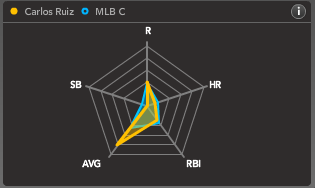
In terms of being a .345 hitter, no. Ruiz is a career .253 hitter. Expecting him to maintain an average nearly 100 points higher is just silly. The inflated early-season average is a result of a ridiculously high batting average on balls in play (BABIP). We talk about BABIP around here a lot, with good reason.
Throughout his career with the Phillies, Ruiz has a .271 BABIP. The average player is around .300, On the other hand, it is not uncommon to see catchers, who tend to be slow, with lower than normal BABIPs. Ruiz’s BABIP thus far in 2010 is a robust, and unsustainable, .403. It is true that a hitter has slightly more control over his BABIP than a pitcher, but not this much control.
Part of the reason for the high BABIP is an increase in line drives, a factor that a hitter can, in fact, control to some extent. Of the most common ways to put a ball in play – line drives, groundballs and flyballs – liners are the ones that go for hits more often than any other. Ruiz has a relatively normal career line drive rate (LD%) of 18.4%; that’s increased to 24.6% so far in 2010. An LD% more than 20% is sustainable, but only four players in the major leagues had a rate of greater than 24% last season.
One would suspect Ruiz’s LD% to settle toward career norms; this would likely create a batting average chain reaction. His BABIP would likely fall, and in turn, so would his batting average. ZiPs updated in season projections have Ruiz with a projected .285 batting average at season’s end. That would mean a batting average of .267 the rest of the way. Even then, a .285 average is more than 30 points higher than his career number, but a lot more believable than the .345 average he boasts right now.
Outside of batting average, the biggest change for Ruiz has come in terms of strikeouts and walks. Since joining the Phillies in 2006, Ruiz has posted favorable rates in terms of walks and strikeouts. His career walk rate (BB%) of 11.6% is decent, and his 12.8% strikeout rate (K%) is more than acceptable. In recent seasons, Ruiz has posted nearly identical K and BB percentages. 2010 has been no different.

What is different is an increase in both numbers. The 31-year-old has increased his BB% to 19.8%, but his strikeouts have also increased to nearly the same level (19.0%). Ruiz is swinging at pitches out of the zone 20.4% of the time, but that is not far off his career number of 17.4%. Pitchers are throwing slightly more fastballs to him, however, nothing that could be considered drastic. More likely, Ruiz has just improved his batting eye in terms of walks, and become more willing to work deep counts, even if it means more strikeouts.
Power-wise, Ruiz has shown decent, not great, pop in his five-year career. His ISO or Isolated Power (slugging percentage minus batting average) of .131 in 2010 is very close to his career number of .133. His home run-to-flyball rate of 9.5 is slightly higher than his career number, although easily sustainable.
If you were able to snag Ruiz as your catcher in the later rounds of your draft, enjoy the early-season success. While the batting average is expected to regress, the increase in walks could give him a very favorable on-base percentage, especially from the catcher position; that could boost his runs scored totals in standard 5×5 leagues. In terms of power, expecting Ruiz to duplicate his nine home runs and 26 doubles from last season is reasonable.
If you’re OK with that production from your catcher, then Ruiz is your man. However, if you have a decent back-up option, you might want to strongly consider selling high on Ruiz and his batting average before the potential BABIP regression sets in. Assuming you can get inflated value for him, of course.
*Carlos Ruiz was diagnosed with a right knee sprain on Wednesday. The injury should not require a DL stint.
For more on Carlos Ruiz and other players with surprising starts, check out Bloomberg Sports’ Fantasy Kits.
(Audio) BTN with guest Ben Kabak of RiverAveBlues
By Bloomberg Sports //
Listen now! – (loads in new browser)
Behind the Numbers
Hosts: Wayne Parillo and Rob Shaw
Guest: Ben Kabak of RiverAveBlues
Total Running Time: 15:40
High Level Look
- Being “zen” during games
- the state of the farm system
- How RAB became so successful
More ways to get Behind the Numbers, talk to us, or just have a good time
(Video) Ballpark Figures: Head-to-Head
By Jonah Keri //
Ballpark Figures: Head-to-Head — Bloomberg Television’s Michele Steele talks some fantasy baseball with Bloomberg Sports Analyst Rob Shaw about the upcoming weekend. Shaw has his eyes on a pitching duel in Tampa Bay between the Rays and Seattle Mariners. For offensive fireworks, check out the Cardinals and Reds. Finally, in reality, Shaw has his eyes on a postseason rematch between the Twins and Yankees. Play ball!
No Regular Johnny Cueto
by Eno Sarris //
On the heels of a complete game, one-hit shutout against the Pittsburgh Pirates, it’s tempting to get excited about Johnny Cueto.
But fantasy owners – and the baseball world in general – have been
excited about Cueto before. And, hey, it’s the Pirates.
After
his 10-strikeout, zero-walk debut in his rookie season, all sorts of
people prognosticated greatness for the effectively wild hurler. In
fact, Rob Neyer wrote about ‘signature significance’ –
the idea that one performance can be so great that it means something
for the career of the performer. While the article Neyer was quoting
mentioned Jason Bere and Luke Hudson, he did make the
excellent point that perhaps there was more significance when the
pitcher was as young as Cueto was (22). Cueto’s rookie ERA did not live up to the hype created by his first start, but he did put up a
8.17 K/9 that seemed to portend good times ahead.
Fast forward to this spring, and the optimism wasn’t nearly that strong. His Bloomberg Sports Fantasy Tools‘
B-Rank going into the season was only 183. That was largely due to his tepid sophomore season in 2009 which produced a much less
exciting strikeout rate of 6.93 per nine innings, as well as another ERA on the wrong
side of four. His home park hasn’t helped – Great American Ballpark
has averaged a 1.25 park factor for home runs
since 2007, meaning that the park augments home runs by 25%.
Nevertheless, Cueto gave up 1.26 home runs per nine innings last year, with a 1.36 rate for his career. He seems to have a bit of a homer problem, but if he was striking out a batter per inning we’d probably forgive him his trespasses.
So what gives? We’ve talked about post-hype sleepers before. Can Cueto recover all that promise that we once thought he had?
Let’s
take a look at the pitching mix, one area we have identified as a part
of the game that young pitchers can mess with in order to improve the
effectiveness of their overall arsenal. In 2009, Cueto was almost a
two-pitch pitcher. He threw his fastball 60.9% of the time and his
slider 28.9% of the time. Strangely, it was his change-up, which he only
threw 9.3% of the time, that got the best whiff rate (14.1%).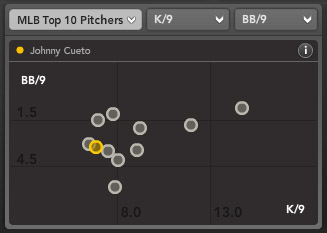
In
2010, he’s thrown his two-seam or four-seam fastball 58.7% of the time,
his slider 31.9% of the time, and his change-up 9.3% of the time. The
mix is largely similar, but the extra use of the slider is worth
noting. While the slider got just slightly above-average strikeout
rates in 2009 (9.7%), the pitch is inching its way back towards elite
territory this year (12.2%). Guess the slider’s rate of whiffs in 2008: 15.8%. His fastball whiff rate is also into double digits after languishing at 5.8% last year. Cueto’s increased whiff rates have led to his strikeout rate inching forward to 7.07 K/9 this year. As you can see
from the screenshot above, this new K-rate puts him in the middle of the
top-10 pitchers’ pack in terms of strikeout and walk rates.
We return now to his
start against the Pirates. Of the 102 pitches in that game, Cueto threw 73 fastballs, 24
sliders and five change-ups. He got four whiffs on the slider for 17% and 14 whiffs on 73 fastballs for 19.2%. It
seems that his nice whiff rate was a big part of his good night. 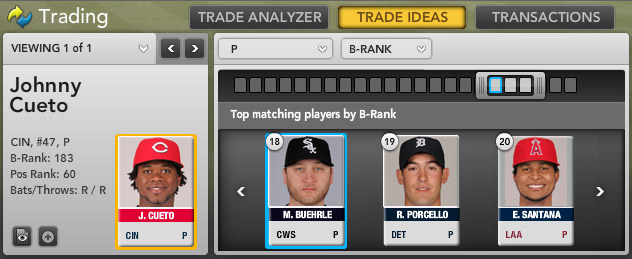
The Bloomberg Sports Fantasy Tools
just added a Trade Analyzer.
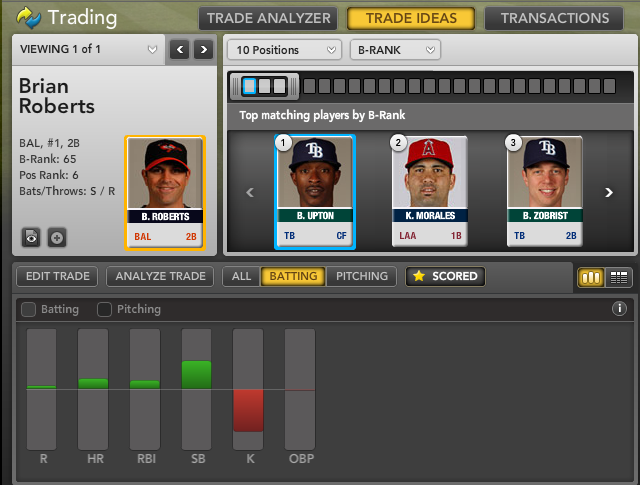
On the left you’ll see a trio of players that the trade machine
suggests might match up with Cueto as trade options. If you have the
chance to trade Mark Buehrle or Rick Porcello for Cueto, now would seem like the time to pull the trigger. The
slider is getting whiffs again, which seems to be a big part of his
original promise. If he can regain the slidepiece stuff that made us
all drool in 2008, he’ll be a boon to fantasy managers in 2010.
For more about trades that might net you Johnny Cueto, check out Bloomberg Sports’ Fantasy Tools.
(Video) Ballpark Figures: Hot Commodities
By Jonah Keri //
Ballpark Figures: Hot Commodities — Bloomberg Television’s Michele Steele talks fantasy baseball with Bloomberg Sports analyst Rob Shaw. The result is a list of Shaw’s Bets and Michele’s Steals! Shaw likes Padres former top prospect Tim Stauffer as a hidden gem (though he is currently on the DL), while Brewers Casey McGehee also gets the thumbs up. Michele is rolling with Aaron Rowand, who has been a major help for the Giants offense.
The Five Types of Trades You’ll See In Fantasy Leagues
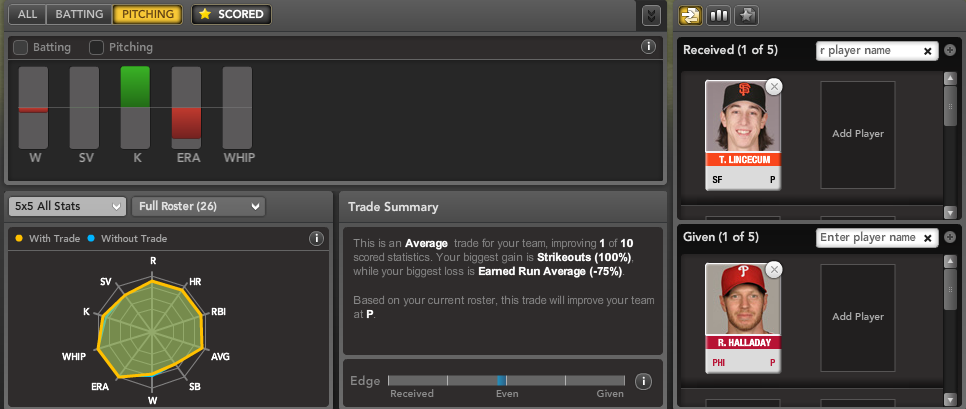
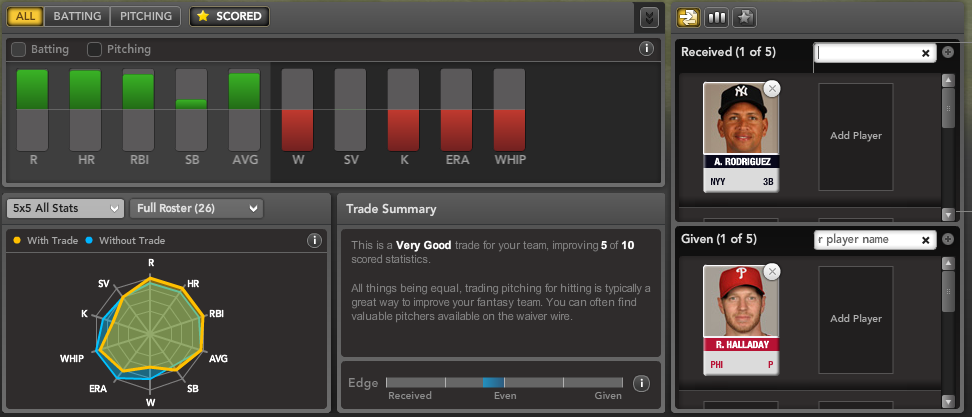
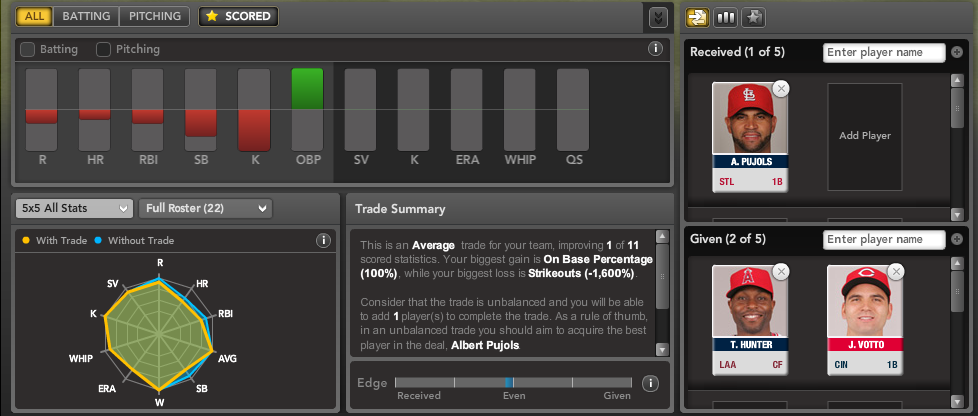
like these aren’t the easiest to pull off. As the Bloomberg Sports tool notes, “As a rule of thumb, in an unbalanced trade you should aim to acquire the best player in the deal.”

Is Darnell McDonald the New Garrett Jones?
By R.J. Anderson //
The Baltimore Orioles selected Darnell McDonald with the 26th pick of the 1997 amateur draft. With just over 200 career big league at-bats, after sharing a class with All-Stars like Lance Berkman, Troy Glaus, Jayson Werth, and teammate J.D. Drew it’s easy to call McDonald’s career a bust. But for right now, McDonald has done his part to inspire the downtrodden Red Sox nation.
Now 31 years old, McDonald is hitting .246/.328/.456 with below-average defense in center but also some huge late-game heroics. The projected starter in center field, Mike Cameron, began a rehab assignment on Monday, and left fielder Jacoby Ellsbury will return at some point in the near future too. McDonald’s power figures to keep him around longer than Jonathan Van Every, but just because McDonald could stick on the Sox’s roster for an additional few weeks, does that mean he should stick on your roster?
In a word: No.
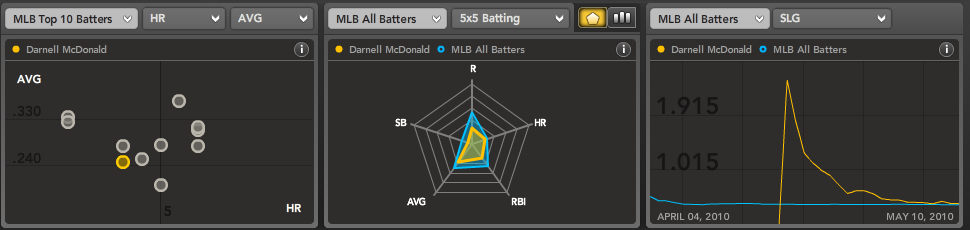
It’s easy to get caught up in McDonald’s triumphant debut with Boston and buy into his power as legitimate. The sample size is still incredibly small, even smaller than McDonald’s stint in Cincinnati last year, in which he hit .267/.306/.400. Even in the minors, McDonald never showed the ability to consistently hit for a slugging percentage over .450. His career Triple-A slash line – which is representative of more than 3,700 plate appearances over a good stretch of his statistical prime – is only .278/.337/.423.
This all seems rather obvious. After all, McDonald is probably out of a roster spot by June and career journeymen are pretty fungible in the fantasy world. However, after the success of Garrett Jones and Casey McGehee or even players like Jack Cust, it’s important to analyze and evaluate each player under their own circumstances, since career minor leaguers can occasionally grow into viable big league fantasy commodities.
McDonald’s story is a nice one of potential redemption and persistence. But he’s just not somebody who will continue to help your mixed league fantasy team no matter how much longer he’ll stick in the majors. In a deep American League-only league, he’s worth holding for a little while longer. Otherwise, you can safely let him pass.
For more on Darnell McDonald and the Boston Red Sox, check out Bloomberg Sports’ fantasy kits
(Video) Ballpark Figures: Stock Report
by Jonah Keri //
Ballpark Figures: Stock Report — Bloomberg Television’s Michele Steele talks with Bloomberg Sports Fantasy Analyst Rob Shaw to discuss the bulls and bears on the stock report. Shaw remains bullish on Carlos Lee, despite his poor season numbers. He tells us to keep Pablo Sandoval on the bench temporarily. Finally, Clayton Kershaw is a great buy low option with his ERA more than a run above last season.
BABIP Laggers, xBABIP and Fantasy Rebound Candidates
by Eno Sarris //
We’ve quoted Russell Carlton’s study about the benchmarks when different statistics become significant plenty of times here. In that study, he basically asked how long it took for a statistic to reliably predict itself in one season. Given a batter’s batting average, for example, how many plate appearances does it take until that average predicts his future in-season batting average to a 70% reliability? The answer, in this case, is never. Batting average is one of the most volatile statistics in baseball, and subsequently we’re always chasing those hits in fantasy play.
While batting average itself doesn’t normalize quickly, there are some interesting quirks in the component pieces. For example, line drive rate becomes significant within 40 plate appearances. In other words, the poor-line-drive-hitting players do actually have something to worry about in the early going. While BABIP doesn’t become significant over one season, one of the main components of BABIP – line drive rate – steadies rather quickly.
It follows that players with poor BABIPs are not created equally. A player with a poor line drive rate (the average line drive rate is around 19%) may end the season with a poor BABIP, and therefore a poor batting average. That makes our mission clear. Let’s take a look at the 10 worst BABIPs in the majors, courtesy of FanGraphs. Not surprisingly, the list is filled with under-achievers.
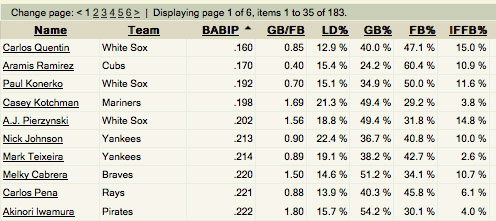
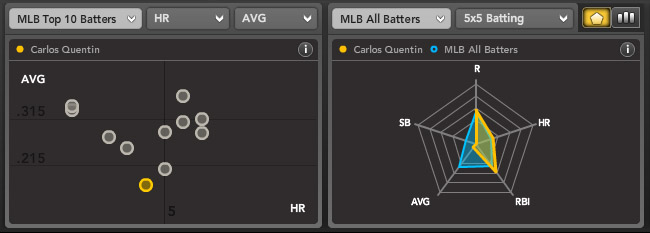
It’s nice how quickly you can get a sense of which of these players is more ready for a rebound in batting average than the rest. For example, Carlos Quentin may have something to worry about. He’s just not centering the ball, and with a poor line drive this year as well as over his career (15.7%), he may actually end up being a guy with power and poor batting averages once we look back on his full career. That’s another way of seeing how misleading batting average can be – even though we are more than 1500 plate appearances into Quentin’s career, there’s a non-zero chance that he’s better than his .248 career batting average so far. On the other hand, this spider graph from the Bloomberg Sports Fantasy Tools might actually show us who he really is.
 There are other names on that list that pop out as ready to bust out. We’ve heard a million times how Mark Teixeira is just a slow starter, he’s got an average line drive rate, and for some reason nearly 80% of his balls in play are becoming outs. That shouldn’t continue, nor should Casey Kotchman continue to be this unlucky on balls in play.
You can use a player’s batted ball profile – their groundballs, flyballs, line drives – and their speed – measured by stolen bases for now – to predict what their BABIP should be. This stat, often called xBABIP, does a good job of pointing out which players are ready for the rebound as well. Here’s the original article, by Peter Bendix and Chris Dutton, that also included an xBABIP calculator.
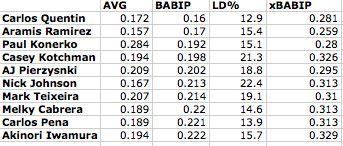 Check out the same 10 players from above, with their batting average, BABIP and xBABIP as columns. Players with the highest xBABIPs on this list suffer from the worst luck and are therefore the best bets for improved batting averages in the future.
So there you have it. Feel good about Nick Johnson, Teixeira and Kotchman, and worry a little about Quentin and Aramis Ramirez in particular. BABIP is always a useful tool when looking at slumping batting averages, but xBABIP and its component stats help us complete the picture.
Statistics updated through 5/9/10. For more on players with slumping batting averages, check out Bloomberg Sports Fantasy Tools.
(Video) Ballpark Figures: Headlines
by Jonah Keri //
Ballpark Figures: Headlines — Bloomberg Television’s Michele Steele talks with Bloomberg Sports Fantasy Analyst Rob Shaw to discuss the latest headlines from the diamond this past weekend. Shaw tells us to pick up the recently perfect Dallas Braden for his starts at Oakland Coliseum. That Bobby Jenks is on the verge of losing the White Sox closer’s gig, while Matt Thornton is a hot pick up. Plus, Shaw tells us that the Phillies and Pirates are cautiously optimistic about the performance of closers Brad Lidge and Octavio Dotel.
 Bloomberg Sports