Category: Dailies
Is Wade Davis Worth Waiting Out?
By R.J. Anderson //
In a past life, Wade Davis attempted to woo Lady Luck. Instead, he clearly offended her, leaving himself hexed for this one. At least, that’s how Davis must feel given his schedule of opponents this season. He started with consecutive games against the Yankees and Red Sox, and has since faced them both twice, along with Texas, the White Sox twice, and the Blue Jays.
Davis endured through a May 19 start against the Yankees, wielding an impressive 3.35 ERA at that point. His ERA now sits at 4.94. His cumulative statistics in those five starts in between:
25.1 IP
36 H
17 SO
6 BB
6 HR
22 ER
That works out to an ERA of 7.89. Simply put: that’s bad. His seasonal numbers suggest that he’s not quite as good as that 3.35 ERA reflected, but he’s far superior to the 7.89 figure. With top prospect Jeremy Hellickson tearing up Triple-A, the question might not be whether Davis is rosterable in fantasy leagues, but rather if the Rays will even keep him on the 25-man major league roster, let alone in the starting rotation.
Lately it seems Davis is on the right path. He’s struggled with his command at times, yet his June strikeout-to-walk ratio is an impressive 15:1. That includes two starts where Davis didn’t walk anyone. The home run bug he’s encountered could be tied partially to bad luck, but also to his predictability in pitching. Here is his fastball usage by count:
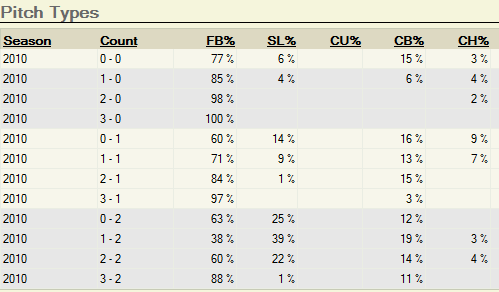
Adding to the confusion is that Davis possesses what most scouting reports describe as plus breaking pitches. Yet, if one were simply to look at his usage patterns, it would seem he’s either uncomfortable throwing those pitches or simply doesn’t want to. Either way, it’s a problem. Part of pitching is having the upper hand when it comes to game theory. If the batter knows what’s coming, he better not know where it’s going, and if the batter doesn’t know what’s coming or where it’s going, then he’s probably not going to hit you well.
Expect a league average or slightly worse performance from Davis heading forward. In standard 12-team mixed leagues, that makes him a fringe starter at best.
The Buccos’ Trio of Treasure
by R.J. Anderson //
Baseball summers in Pittsburgh have largely consisted of apathy and agony since the departure of one Barry Bonds. This summer is a bit different from the past few, though.
General manager Neal Huntington is now adding players to the roster rather than subtracting and reshuffling. These players are worth noting because they’re all products of Huntington’s era, whether via trade or the draft. Clearly he feels they’re worth rostering right now, but should you? Let’s take a look.
SP Brad Lincoln
Drafted out of the University of Houston in the same draft that saw fellow collegiate arms Andrew Miller, Tim Lincecum, and Brandon Morrow also go top 10, Lincoln suffered a similar initial fate as most recent Pirates’ pitching prospects: He suffered an arm injury that delayed his progression through the system.
The 25-year-old has made two starts thus far, and it’s only 12 innings, but boy, what an ugly 12 innings they’ve been. He’s not missing bats or avoiding walks – his K and BB rates are identical at 3.75/9 IP, and his whiff rate is a low 3.8%. The good news is that Lincoln should be better than this moving forward. Throughout the minors he did a nice job avoiding walks, but had issues when it came to keeping the ball within the playing area (he averaged more than one home run per nine innings pitched). It’s hard to expect anything more than a league-average performance from Lincoln this year, but in NL-only leagues he’s worth a look.
OF Jose Tabata
Acquired in the Xavier Nady/Damaso Marte trade of summer 2008, Tabata is best known for his wife’s legal issues, and persistent questions about his age. He’s supposedly only 21 years old, which makes him among the game’s youngest major leaguers. Through 31 plate appearances Tabata holds a line of .259/.355/.444. That’s well above what one should expect from him when age and his Triple-A career .296/.358/.419 line are considered. Unless the idea is to try and catch lightning in a bottle, he’s probably not worth an add, outside of very deep keeper leagues.

3B Pedro Alvarez
And finally, the cream of the crop. Alvarez made his major league debut on Wednesday night. He bats lefty and plays third base – for now, at least – which gives him instant value. Prior to his promotion, Alvarez was hitting .277/.363/.533 in Triple-A, with 13 home runs in 278 plate appearances. Of the three players, it’s most difficult to be realistic in assessing Alvarez. Given his status as an elite prospect and draft pick, he very well could burst onto the scene in a fashion similar to Evan Longoria or Ryan Braun. Or he could take some lumps in his first major league taste, and be a more attractive option come 2011. Either way, he’s worth a grab, assuming he’s somehow still available in your league. If you have a FAAB budget, break the bank.
(Video) Ballpark Figures: Dose of Reality
By Bloomberg Sports //
Ballpark Figures: Dose of Reality — Bloomberg Television’s Michele Steele and Bloomberg Sports Fantasy Analyst Rob Shaw talk some fantasy baseball with Big Leaguers.
The Carlos Santana Experience Invades Cleveland
By Tommy Rancel //
In the summer of 2008, the Dodgers acquired Casey Blake from the Cleveland Indians. Blake, 36, was a soon-to-be free agent after the season. In exchange for a few months of Blake’s services, the Dodgers parted ways with catching prospect Carlos Santana and minor league relief pitcher Jonathan Meloan.
The Dodgers re-signed Blake after the ’08 season, and the four-corner man (1B/3B/RF/LF) has been a good player for Los Angeles. On the other hand, he is far from an impact player. While it may have not seemed like it at the time of the trade, one of the players sent to the Indians may indeed become an impact player.
Jon Meloan has bounced around the league, from Cleveland to Tampa Bay to Oakland. Meanwhile, Carlos Santana has become a top-10 prospect in baseball. With the Indians already out of the race 2010, the focus has shifted to the future.
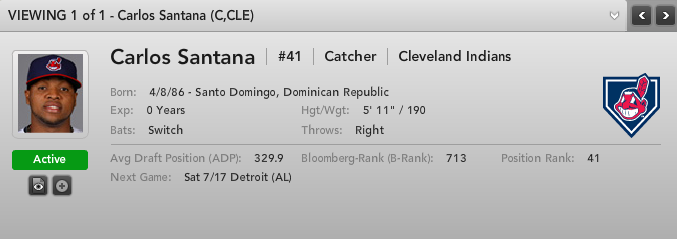
Santana figures to be a key part of that future. A former third baseman/outfielder, Santana was converted to catcher in 2007. His defense is still questionable, but Santana’s ability at the plate has him ready for the big leagues right now.
In 2008, while splitting time between the two organizations, Santana hit .326/.431/.568 (AVG/OBP/SLG) with 21 home runs and 117 RBI. That said, 560 of his 568 plate appearances came at the Single-A level. The Indians promoted him to Double-A in 2009, and he responded by hitting .290/.413/.530 with 23 home runs and 30 doubles. Ready for the top level of the minors in 2010, Santana appeared in 57 games for Triple-A Columbus – compiling a slash line of .316/.447/.597 with 13 longballs in just 246 PAs.
Along with a good batting average, and very good power (.241 Isolated power, aka slugging minus batting average, in 2009), perhaps Santana’s greatest skill is his batting eye. As a member of the Indians farm system, he walked 145 times and struck out just 132 times over the past two plus seasons. Throughout his minor league career, he has 333 walks and 322 strikeouts. It is that fantastic plate discipline that should help ease the transition from a good minor league hitter to a good major league one.
So far, so good. In his first four games as a major leaguer, Santana had three walks and just one strikeout. He also belted his first major league home run on Saturday. Although his batting average may take an initial hit at the top level, his plate discipline should keep him on base at an above-average clip.
Despite playing in the same division as Joe Mauer, don’t expect Mauer-like production, at least not right away. Meanwhile, looking at the man Santana indirectly replaced, Victor Martinez, we may have a more apt comparison. If Santana is on your waiver wire, put in a claim immediately in all mixed-league and AL-only formats.
Not much has gone the Indians’ way in 2010, but Santana’s supernatural on-base ability should be fun to watch this summer.
For more on Carlos Santana and other top prospects, check out Bloomberg Sports’ Fantasy Kits.
(Audio) BTN with guest Chris Liss of Rotowire
By Bloomberg Sports //
Listen to it now! – (loads in a new browser)
Hosts: Rob Shaw and Wayne Parillo
Guest: Chris Liss of Rotowire.com
Topics
- Why he does doesn’t like projections
- Winning Tout Wars
- A message to scared fantasy owners
How you can get Behind the Numbers:
(Video) Ballpark Figures: Hot Commodities
By Bloomberg Sports //
Ballpark Figures: Hot Commodities — Bloomberg Television’s Michele Steele and Bloomberg Sports Fantasy Analyst Rob Shaw reveal their weekly sleepers.
Lilly and Velocity: Fantasy Buy, Sell or Hold?
by Eno Sarris //
There are a lot of different ways to look at Ted Lilly and his season so far.
1) He’s doing fine. He has a 2.90 ERA, a 1.00 WHIP, and is only 2-5 because of a poor offense behind him. The Cubs have scored the third-fewest runs in baseball, so Lilly is good for everything but wins. Just check out his Bloomberg Sports Fantasy Tools spider graphs! He’s elite in every category but strikeouts. This is not a crazy way to look at Lilly – he’s never been about strikeouts anyway, and he’s still got his trademark control. Buy!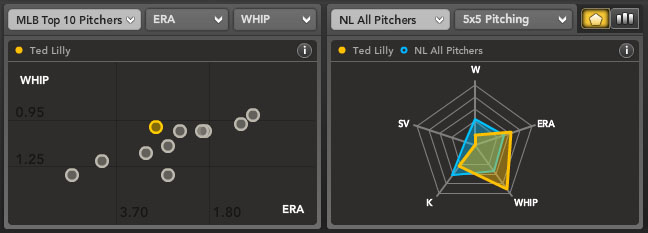
2) He’s heading for disaster. He’s sporting a career low in strikeouts per nine innings this year (5.66). A drop in strikeouts for a veteran is worrisome enough, but Lilly hasn’t ever averaged below 6.84 K/9 for a full year, and the lowest average he has put up in the National League was 7.57 in his first year with the Cubs. This is not a dip, it’s falling off the table bad. And Lilly’s walk rate, though still solid (2.37 BB/9), has gone up from last year (1.83 BB/9).
Lilly is also suffering from his worst fastball velocity in years – one system has him at 85.6 MPH, and one at 86.4 MPH. Both are far below his normal ~88 MPH level. Add to all this the fact that Lilly is a flyball pitcher (34.4% career groundball rate) and suddenly you can envision that home run rate (1.05) starting to inflate closer to his career number (1.35) once Wrigley Field starts warming up. Lower velocity, fewer strikeouts, more walks, and more home runs on the way? Sell!
As usual, the truth lies somewhere in between the two extremes. A pitcher with an 88 MPH fastball obviously doesn’t rely on blowing people away for his success. His current walk rate is in line with his National League walk rate (2.36 BB/9) and he’s getting his pitches in the zone at exactly his career rate (54.7%). It’s a little worrisome that his contact rate is up (83.7% this year, 79.7% career), but we have not yet tackled his velocity fully.
It may be tempting to point to his arthroscopic surgery and the reduced velocity and wipe your hands of Lilly. The surgery did go into the labrum, and labrum surgeries have ruined many careers. But the surgery only repaired a little fraying, and was done soon after last season ended. He’s now put seven months between himself and the surgery, and lo and behold, look at his velocity charts for the most recent games (courtesy www.fangraphs.com). See how he’s been his old self again in the last two starts? Maybe Lilly just needed a little time to get back to his prior form. You might notice that his K/9 in those last two starts was a decent 6.19 (11 strikeouts in 16 innings). While velocity alone does not a good pitcher make, given average movement (and Lilly’s movement is not elite), a faster fastball is always better. Here’s some great work on the subject by Jeremy Greenhouse at Baseball Analysts.
As a flyball pitcher, Lilly will always have the risk of the home run looming (or flying) over his head. A 1.3+ HR/9 rate is not a comfortable place to be for most pitchers. Had he put up his 1.35 career HR/9 rate last year, for example, he would have been sixth-worst among ERA title qualifiers in the category. But Lilly always makes up for this flaw by not walking anyone (and thus keeping his WHIP low); the home runs he allows are often solo shots. Because he helps in WHIP, doesn’t (usually) hurt in strikeouts, and will hopefully start to win some games, he’s still a valuable pitcher despite the lack of a marquee name.
And since he still gives up those home runs, hasn’t pushed the average velocity needle back over the hump, and hasn’t yet struck out enough batters to register in that category, he can be hard to trade. Especially in leagues where other managers know how to find the velocity of a pitcher, that makes Lilly a “hold” in most formats.
For more on Ted Lilly and other options for the middle of your fantasy rotation, check out Bloomberg Sports’ Fantasy Tools.
Joe Mauer and His Power Outage
By Bloomberg Sports //
Last season’s AL MVP, Joe Mauer, has seen his home run numbers drastically decline this season as compared to his 2009 level. Mauer hit a career-high 28 homers during his MVP campaign, but so far this year he has hit only two.
Using Bloomberg Sports’ statistical tools, we can see that Mauer’s home run output both in 2009 and in 2010 were uncharacteristic, and that his power numbers should regulate somewhere in between the two.
First, it must be mentioned that Mauer’s OPS in 2009 was unusually high for his career, and a neutral observer might conclude that 2009 was a fluke. Others could argue that this surge had to do with natural age progression, as he reached the age of 26, a milestone at which many players begin to peak. Thus, despite Mauer’s current career OPS of .887, it could be argued that his 1.031 2009 OPS would have some staying power. Mauer’s monster season prompted the Twins to hand him an eight-year, $184 million contract extension in March.
Mauer’s two homers this year-to-date have thus raised concerns in Minnesota. We can point to his fluctuating home runs per flyball rate as a cause of this season’s power outage – as well as Mauer’s 2009 outlier season. From 2005 to 2008, that rate ranged from 6.5% to 10.8% — league average typically hovers around 10%. However, in 2009, Mauer’s HR/FB rate jumped to a stratospheric 20.4%. Thus maybe this shift, rather than indicating anything in particular about Mauer’s game, indicates that a lot of Mauer’s power in 2009 was the result of a statistical variation. If this dramatic increase had been accompanied by a drastic change in body type it would be understandable, but Mauer’s body did not noticeably change.

This season, Mauer’s homerun per fly ball out rate has regressed to just 5.7%, a career low, but also closer to the pre-2009 range. The numbers clearly point to 2009 being an outlier in this respect. Granted, a couple of unmentioned variables might be pulling down Mauer’s HR/FB rate this year. One, the Twins’ move to Target Field from the Metrodome might be affecting his power numbers, especially through the early, colder-weather months of the season. Second, pitchers might be attacking Mauer differently this season, following his ’09 power outburst. Let us explore these two possibilities.
Mauer’s new home, Target Field, has been the third-worst ballpark for home runs, in front of only Citi Field and the Oakland Coliseum, according to ESPN.com’s MLB Park Factors. However, through just over one-third of the season, it is tough to say that this phenomenon is reliable or that it will remain constant. After all, it typically takes three years before you can properly trust a given stadium’s park factor. Meanwhile, Mauer’s previous home, the Metrodome, played as roughly home run neutral. The dimensions of the two fields are very similar, so expect Target Field to be less home run-stubborn than it currently is, especially in the warmer summer months. To date, Mauer’s OPS is 80 points lower at home than away.
Maybe pitchers are attacking Mauer differently too. This argument could potentially explain some of the catcher’s power struggles. Pitchers, in fact, have been unwilling to throw him fastballs in certain counts, and seem to have replaced them with changeups, and occasionally curveballs. In 2009, on 0-1 and 2-2 counts, Mauer saw a majority of fastballs. However, this season, in the same counts, he’s seen a fastball only about one-third of the time. This change by the pitchers seems smart, as Mauer had a lethal 1.077 OPS against four-seam fastballs from 2006 through 2009. Meanwhile, he now sees almost three times as many curveballs on the first pitch and in 2-2 counts, according to Bloomberg Sports tools, when compared to 2009. This adjustment by pitchers seems appropriate, as Mauer had a .483 OPS against curveballs dating back to ’06. Lastly, Mauer has seen more changeups in 1-2, 2-1, and 2-2 counts, although he has fared well against the changeup in his career, so this adjustment should have had no effect.

Target Field’s low home run rate and the new approach by pitchers may be hurting Mauer’s home run numbers. But the statistical variation in his HR/FB rate also helps explains the drastic difference between 2009 and 2010. That rate suggests that Mauer’s MVP-type numbers may have been affected by a statistical outlier, and that fans and teams may have to reassess their expectations for Mauer’s power numbers. In regards to how pitchers are approaching Mauer, it seems unlikely that the recent adjustments can explain this year’s low home run total, as he has been a top player in the league since 2004, and pitchers have been adjusting to his tendencies every year. Meanwhile, Target Field has been playing like a large shopping mall – but it does not explain Mauer’s low road home run total, or the fact that he has yet to hit any homers at home.
Expect a middle ground to emerge between the home run binge Mauer showed last season and the drought he’s experienced in 2010.
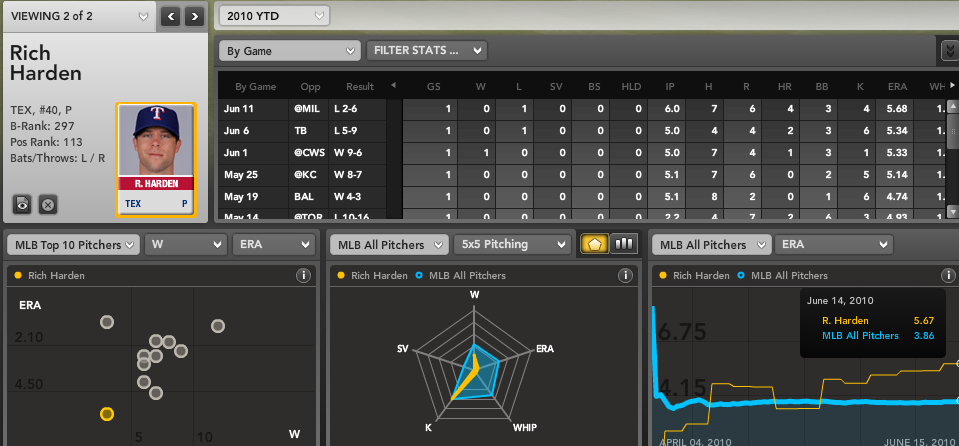
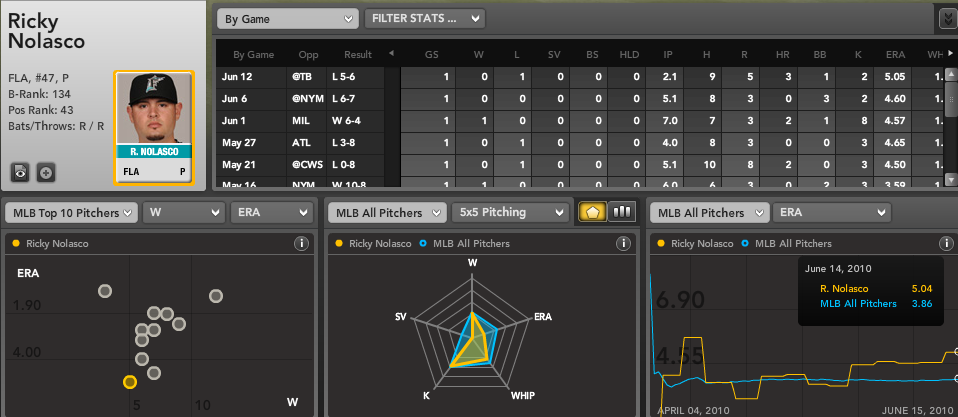
Should You Hold Onto Wandy Rodriguez, Rich Harden, and Ricky Nolasco?

(Video) Ballpark Figures: Stock Report
By Bloomberg Sports //
Ballpark Figures: Stock Report — Bloomberg Television’s Michele Steele and Bloomberg Sports Fantasy Expert Rob Shaw talk some fantasy baseball. Today they discuss the Bulls and the Bears on the Stock Report.
 Bloomberg Sports