Category: Dailies
David Price’s Fastball Goes Bezerk
By R.J. Anderson //
A few things about David Price’s fastball were evident entering Wednesday night’s start versus the Boston Red Sox:
1) It goes fast:
Pitchfx data has his average four-seamer at 94.8 MPH and his two-seamer clocking in at 90.7 MPH.
2) Hard to hit:
A poll of, say, 300 baseball fans right now asking which starting pitcher has the fastball most difficult to hit would probably yield results that showed Stephen Strasburg’s heater near the top. As it turns out, Strasburg gets whiffs 9.2% of the time. Price? 9.1%. Not too shabby.
3) He uses it a lot:
More than 70% of the time, as it turns out.
Combine that information with a Boston lineup missing Jacoby Ellsbury, Dustin Pedroia, and J.D. Drew (Drew not for health reasons) and nothing about Wednesday night’s game should surprise. Price’s fastball sat around 93-95 all night long, topping out at 96.9 MPH. He threw it constantly. Thirty-nine of his first 40 pitches were heaters, 100 of 111 overall. He pounded the zone with it too; more than 75% of his fastballs were strikes of either swinging, called, or foul variety.
The most amazing aspect of the start was that as Price continued to pump fastballs, everyone sort of caught on. Undoubtedly the Red Sox realized he was doing his best Mariano Rivera impression by tossing almost nothing but fireballs, yet they simply couldn’t hit any of them. Not only did Price strike out 10 Red Sox (while allowing only two earned runs and walking one), he also turned up 19 swinging strikes on those 100 fastballs. That’s an absurd 19% whiff rate. As mentioned before, Price’s seasonal rate is a little less than half that. To say Price’s heater was working in all its glory last night then, is an understatement.
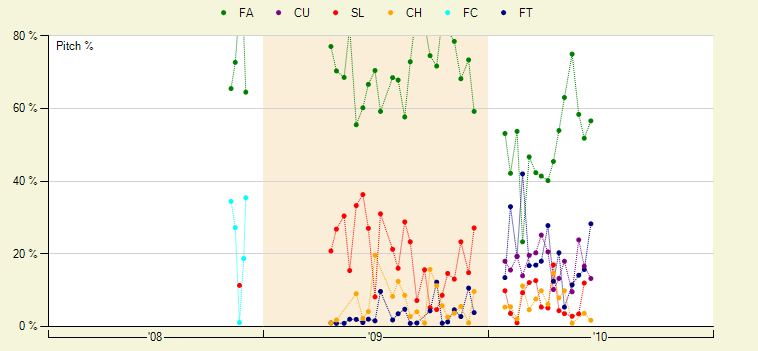
Graphic courtesy of FanGraphs.com
All in all, it was one of the best starts of Price’s season. Which is really saying something, since Price leads the American League in wins (with 12), trails only Cliff Lee in ERA (2.42), and has shown progress in various fielding independent metrics (3.61 FIP). The former number-one pick is bridging the gap between potential and production in only his second full season in the majors.
If you own Price in a keeper league, go ahead and slap the franchise tag on him. If you own him otherwise, sit back and continue to enjoy the maturation of a rising ace.
For more on David Price and other Egyptian-based dinosaur deities, check out Bloomberg Sports’ fantasy kits.
Is it Time to Trust Gavin Floyd?
By Tommy Rancel //
Despite his obscurity on a national level, Gavin Floyd has been one of the more polarizing figures in fantasy baseball over the past couple seasons. Few have teased and burned owners like Floyd has. This season has been more of the same. Still, it’s time to give Floyd another chance.
As in seasons past, Floyd has toyed with owners’ emotions in 2010. He started out awful, but has since rebounded nicely. Jason Collette of fanball.com notes that Floyd’s 1.27 ERA over the past 30 days rivals that of another Bloomberg Sports’ favorite, Josh Johnson (1.22).
So what has changed since those lousy first few weeks? Mostly luck.
In early May, Eriq Gardner noted at Bloomberg Sports that Floyd was one of baseball’s “unlucky” pitchers due to a below-average left on-base percentage (LOB%), also known as strand rate. On average, pitchers strand 72% of men who reach base. For his career, Floyd has stranded 69% of baserunners.
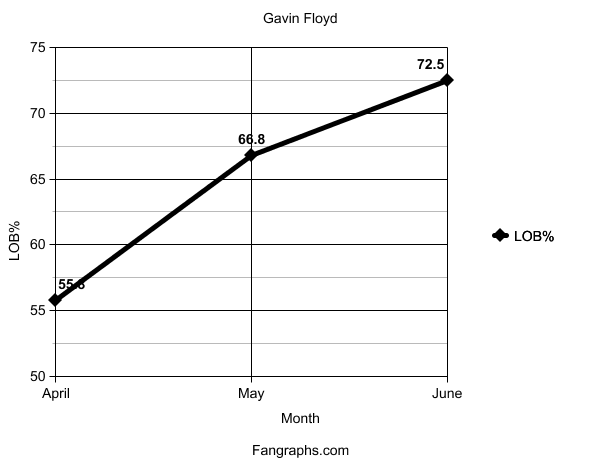 In the early stages of the season, Floyd’s LOB% was around 56%. Because of that, his numbers – most notably ERA – suffered. However, as the season has progressed, Floyd’s strand rate started to regress toward league average, an occurrence which has positively affected his stats, especially ERA.
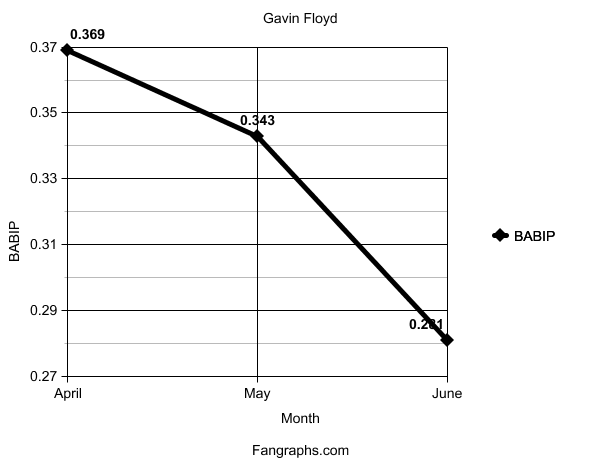
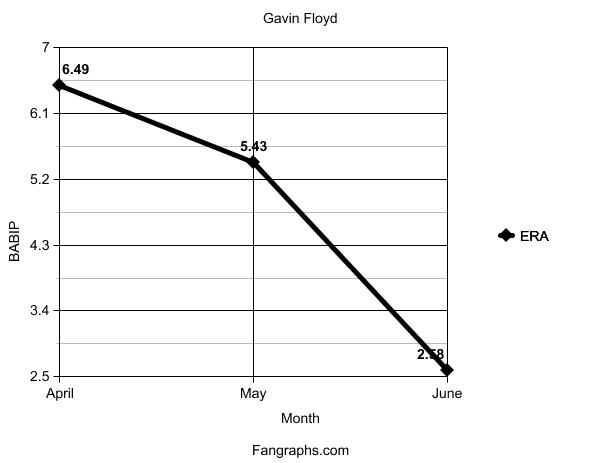 In conjunction with his LOB% regression, Floyd has seen a regression in terms of batting average on balls in play (BABIP). The league average BABIP is .302. In April, Floyd’s BABIP was .369. To date, his BABIP has dropped down to .322 — but it’s still well above his career mark of .295.
 Looking at events he can control, such as home runs, walks and strikeouts, Floyd is enjoying the best season of his career. His strikeout per nine innings rate (K/9) of 7.47 tops his career K/9 rate of 6.84. He’s walking fewer batters per nine innings (BB/9) in 2010 (2.78) than in previous years (3.22). The righty has also cut his home runs per nine innings rate dramatically, from a 1.25/9 IP career mark to 0.61/9 IP in 2010.
Looking at home run-to-flyball ratio, home runs might be the only category in which Floyd sees a shift toward the negative (an unusually low 7.3% HR/FB rate this season, vs. 12.4% for his career).
While Floyd has been a poster child for regression, his raw statistics still show an average pitcher. He is just 4-7 on the year with an ERA of 4.43. There is a chance that his LOB% and BABIP – which are still higher than usual – could regress even further. Couple that with his other peripheral stats that remain above-average in a positive way, and now is the time to strike on Floyd. He is available on waivers in nearly 10% of fantasy leagues. But even if he’s owned in your league, he’s worth a trade request.
For more on Gavin Floyd and other regression ready candidates, check out Bloomberg Sports’ fantasy kits.
(Video) Ballpark Figures: Fantasy Headlines
By Bloomberg Sports //
Ballpark Figures: Fantasy Headlines — Bloomberg Television’s Michele Steele and Bloomberg Sports Fantasy Analyst Rob Shaw discuss the fantasy effects of important MLB injuries.
(Audio) BTN with guest Jonah Keri
By Bloomberg Sports //
Listen now! – (loads in a new browser)
Behind the Numbers
Hosts: Wayne Parillo and Rob Shaw
Guest: Jonah Keri, who can be found at JonahKeri.com and follow him on twitter
Total Running Time: 19:10
Topics
- Why Jonah is Wayne’s favorite Canadian
- Pitchers to keep an eye on in the second half
- Why league batting average is down
- Whether Boston fans should worry
Direct link to the conversation
More ways to get Behind the Numbers, talk to us, or just have a good time
- RSS feed
- on iTunes
- Feedback or questions for the hosts
- Win money and play Bloomberg Sports Batter’s Box
Shin-Soo Choo Replacements
By R.J. Anderson //
As far as non-Cleveland Indians fans are concerned, Shin-Soo Choo’s trip to the disabled list comes at a pretty horrible time. Beyond the fantasy implications, Choo’s sprained thumb means he’ll miss the All-Star game, weakening the American League roster and watching experience alike. In his place, Fausto Carmona will represent the Indians in the mid-summer classic and Michael Brantley will be recalled to replace Choo on the Indians roster. Since the Indians are replacing Choo with Brantley, does it mean fantasy owners can do the same?
Short answer: no. The 23 year old acquired in the CC Sabathia trade of 2008 has 157 major league plate appearances with the Indians with a line of .278/.329/.313. His minor league statistics shed some more light on what Brantley’s roof might be: .284/.364/.377 in 806 Triple-A plate appearances with 57 stolen bases on 67 attempts. That is to say: Brantley is a speedster without much pop, but a decent ability to reach base and promptly take a few others by force.
Choo was hitting .286/.390/.475 with 13 blasts in a little over 350 plate appearances this season. Meanwhile Brantley has hit 13 home runs in the minors since the 2008 season began. The similarities outside of team and position between Choo and Brantley are few and far between, which means if replicating Choo’s strengths is your main goal then Brantley isn’t much of an option whatsoever.

The Cleveland player who may stand to benefit the most from Choo’s absence is Shelley Duncan. The former Yankee farmhand has racked up 68 plate appearances this year while hitting .267/.353/.500. He won’t continue to hit quite that well, as his Triple-A career line is only .275/.370/.529, but his skill set is far more similar to Choo’s than Brantley’s. Odds are, you aren’t finding someone like Brennan Boesch on the open market to grab for no cost; so while Duncan is hardly optimal he might make more sense after doing opportunity cost analysis. A roster spot at this point in the season is less valuable than a productive player.
For more on Shin-Soo Choo and other injured stars, check out Bloomberg Sports Fantasy Tools
What the Trade Deadline Means for Fantasy Baseball
by Eno Sarris //
The trade deadline isn’t until the end of the month, but enterprising contenders are already making the rounds and looking to pick the carcasses of teams less fortunate. Every extra start or at-bat that the contender can get out of the fresh meat is a start or at-bat in their favor, so they might as well get going.
Fantasy owners might take note here and get ahead of the eight ball themselves. The danger in AL- and NL-only leagues is that a fantasy owner’s player gets traded out of their league and creates a hole on their roster. Another danger is that a player moves from a beneficial situation to one less supportive of their skills. Let’s run down the top ten trade targets in the rumors currently and talk a little about where they might land and what that would mean. We’ll handle the pitchers today, and the hitters early next week.
Cliff Lee
Lee owners in AL-only leagues should be shopping him as hard as they can. Some might even counsel that Lee owners should take whatever they can get, perhaps from a team in the bottom half of the table looking for a home-run shot. Apparently Lee has told his teammates he’s already made his last start for the Mariners (and then he promptly denied it in the media). The worst news is that many of the most-rumored spots for Lee are in the National League. The Mets, Phillies and Cardinals have all been linked to the lefty with the insane strikeout-to-walk ratio (just look at the Bloomberg Sports Fantasy Tools spider graphs and see how pretty his work has been). Lee owners might take heart that the Yankees and Twins have also been included in the rumors. Even though the source might be a little old, Geoff Baker of the Seattle Times said on June 24th that the Mets and Twins were the favorites to land Lee, and that seems to make the most sense. The thing is, the Twins aren’t known for making big trade deadline pickups, as the lede in this MLB.com article about the Orlando Cabrera pickup states. That kind of move seems more up embattled Mets’ GM Omar Minaya’s alley. Keep Lee in an AL-only league at your own peril.
Kevin Millwood
Millwood is actually second-most likely starting pitcher to be traded to Lee. Because of his advanced age (35), rough ERA (5.40), expiring contract, and the Orioles’ record (24-54), if anyone wants him they can probably get him. The thing is, he’s sporting his best strikeout rate since the last time he was in the National League (7.00 K/9) and a walk rate that is right in line with his career number (2.78 BB/9). He’s giving up a few too many home runs (1.69 HR/9), and that’s will happen to a flyball pitcher (42.9% GB% career) in the AL in a tough park for pitchers (1.283 park factor for home runs). Given his nice underlying statistics, and his success in the NL in the past, Millwood is less of a loss for AL-only owners and more of a potential pickup for NL-only owners. He’s not someone to bust your FAAB budget on, but he’s certainly worth some money, especially if he ends up in a park that suppresses home runs like Citi Field (.595 park factor for home runs) or Busch Stadium (.763 park factor for home runs).
Roy Oswalt
The sharks circling Houston are a little less rabid despite the obvious state of that carcass, but that’s perhaps justified in the case of Oswalt. He is due $16 million next year and has a $2 million buyout in 2012. That’s a lot of money for a pitcher that is 32 going on 33, never had an elite strikeout rate, and has a body type that some feel doesn’t age well. On the other hand, Oswalt is showing the second-best strikeout rate of his career and is pitching the best he has in about four years. Because of the money, he’s a little less likely to change hands. Even with owner Drayton McLane saying he would eat some of Oswalt’s salary, the only team linked to the pitcher so far has been the Rangers. That’s a bit ironic, considering their financial situation. It’s also worrisome to NL-only Oswalt owners.
Ted Lilly
The Cubs aren’t used to being sellers, but they are 10.5 games out, 11 games under .500, and have a -24 run differential. They don’t look good. Many of their problem players have salaries that are too onerous to trade – no team will want to take on the rest of the Alfonso Soriano or Carlos Zambrano contracts, for example – but then there’s Ted Lilly. We talked about Lilly as a fantasy hold – his velocity is returning, and he’s showing a nice ERA – but his strikeout rate is still lagging, and he’s still an extreme fly ball pitcher. Look at the difference between his xFIP (4.60) (expected Fielding Independent Pitching, a number that strips out batted ball and home run luck to produce a figure on the ERA scale) and ERA (3.12). If the Cubs are smart enough to sell, they’ll get some interest in Lilly, but the trade rumors have been light so far. GM Jim Hendry might give the team as long as he can before selling a piece like Lilly, so fantasy managers should probably take the same approach.
Dan Haren
Though the Diamondbacks are obviously cleaning house, the feeling is that the team would have to be ‘overwhelmed’ to trade their ace. First of all, it might be selling low, because despite secondary statistics in line with his career rates (8.90 2010 K/9, 7.71 career K/9; 1.70 2010 BB/9, 1.96 career BB/9; 41% 2010 GB%, 44.1% career GB%), his ERA is not pretty (4.56). Secondly, he only costs about $33.75 million from 2010 until 2012 according to Cot’s Contracts. It wouldn’t make much sense to trade an underpaid ace at a lowpoint in his value. It’s much more likely that the team trades some of its veteran position players.
Fausto Carmona
The Indians are terrible (31-47), and Carmona is cheap ($11.375 million combined 2010/2011), but it will be interesting to see how much teams will want to pay for his services. He relies very heavily on his sinker-inducing ways (58.6 GB% this year, 60.8% career). When his control eludes him (3.16 BB/9 this year, 3.78 career), he can be terrible. But right now, despite his inability to strike people out (4.73 K/9), he’s doing well enough to elicit interest (3.68 ERA, 1.28 WHIP). On the other hand, named suitors don’t abound (the Mets “aren’t interested‘ according to Joel Sherman), and his fantasy trade value is hard to gauge. Carmona may be one of those players that fantasy managers are happy to have owned when he was going well.
The Relievers
This group may include the most-dealt pitchers on the list, as relievers cost less in both contracts and salary. They also are perceived as difference-makers for contending teams with poor bullpens, rightly or wrongly. Heath Bell tops the list, as his Bloomberg Sports Fantasy Tools spider chart shows. His owners should be slightly nervous, as rookie GM Jed Hoyer is 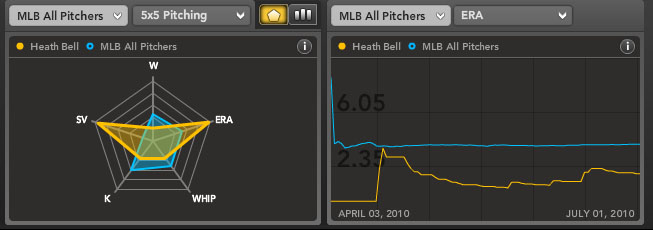 talking about adding offense, and has two ready-made replacements in Mike Adams and Luke Gregerson, but as long as the team is going well, Bell should remain in San Diega.
Kevin Gregg, on the other hand, might change hands if someone wants him. Toronto isn’t going to the postseason, and they also own Jason Frasor and Scott Downs, so teams needing bullpen help will be calling. The thing is, Frasor and Downs have been pitching better and are free agents at the end of the year. They might be preferable to contending teams, and with Gregg’s bloated ERA (4.20) and walk rate (5.40), he could just stay in Toronto.
David Aardsma is struggling (5.33 ERA), and is also cheap (arbitration-eligible for three more years), so he’ll probably stay in town despite the odd rumor. If he does leave, it’s Brandon League that will take over. Octavio Dotel has surpassed expectations and is obviously not in the long-term plans for the Pirates, so his owners should be worried. Suitors are not yet obvious, though, and his perceived value is probably not too high. His owners could shop him to saves-starved teams to be ahead of a possible trade, on the other hand.
For more on Cliff Lee and other possible trade-deadline movers, check out Bloomberg Sports’ Fantasy Tools.
(Video) Ballpark Figures: Head-to-Head
By Bloomberg Sports //
Ballpark Figures: Head-to-Head — Bloomberg Television’s Michele Steele and Bloomberg Sports Fantasy Analyst Rob Shaw talk some fantasy baseball. The topic is the weeks ahead and what fantasy managers should expect from the Seattle Mariners.
Josh Willingham Laying Down The Hammer in D.C.
By Tommy Rancel //
When the Nationals acquired Josh Willingham and Scott Olsen from the Marlins in exchange for Emilio Bonifacio and a pair of minor leaguers before the 2009 season, it was Olsen who was thought of as the key player in the deal. After all, he was a 24 year-old left-handed starter who had made at least 30 starts in each of the previous three years without a trip to the disabled list.

Willingham was a throw-in perhaps, a soon-to-be 30 year-old serviceable outfielder with some okay offensive numbers. Marlins President of Baseball Operations, Larry Beinfest admitted money was one of the reasons the deal was made as both players were entering their first year of arbitration.
Things turned out a little differently. Although he escaped the DL in Florida, Olsen has been bit by the injury bug in Washington. He has made just 19 starts since the trade – tossing 105.2 innings with a 4-6 record in two seasons. On the other hand, Willingham has become one of the best offensive players in the National League no one is talking about.
After posting a more than respectable slash line (AVG/OBP/SLG) of .260/.367/.496 with 24 home runs, 61 RBI and 70 runs scored in 2009, Willingham is turning in his best work in 2010. The former catcher is hitting a modest .273; however, he is slugging .502, and is getting on-base at a .405 clip. Both would be career highs for a full-season.
Whenever a player has a breakout season beyond the age of 30, some will assume it is a fluke or an outlier. In a lot of cases this is true. That said, Willingham is on a steady four-year OPS incline suggesting that he maybe nearing – or right at – his career peak.

If you are looking for fluke stats – good luck. His batting average on balls in play (BABIP) of .295 is lower than his career .299 number. His ISO (Isolated Power), which indicates raw power by taking slugging percentage and subtracting batting average, is .229, or within 15 points of his career .215 average.
The biggest change for Willingham in 2010 is better plate discipline. He is walking 15.8% of the time (up from 11.5% career), and is striking out slightly less (22.1% in 2010, 23.1% career).
Despite the .907 OPS and a .403 weighted on-base average (wOBA), an advanced metric that measures multiple offensive numbers and is scaled to mirror OBP, “The Hammer” is only owned in 55% of leagues according to hotboxsports.com.
Because of his age and contract status (one more year of arbitration), Willingham could be a trade candidate in both leagues should the Nationals choose to sell. That would make him a slight risk in NL-Only formats. Nevertheless, there is no reason to wait on grabbing him off of waivers – if you’re lucky enough – or through a trade in mixed leagues right now.
For more on Josh Willingham and other breakout candidates, check out Bloomberg Sports Fantasy Tools
(Audio) BTN with Rob Neyer (part 2 of 2)
By Bloomberg Sports //
Listen to part one – (loads in a new browser)
Listen to part two – (loads in a new browser)
This is part 2 of a 2 part interview
Hosts: Wayne Parillo and Rob Shaw
Guest: Rob Neyer of ESPN and Rob Neyer Baseball
Total Running Time: 20:04
Topics
- Hall of Candidates including Keith Hernandez, Andy Pettitte, and Jamie Moyer
- The lack of backlash agains greenies
- The Pesky-Stuart debate
Direct link to the conversation
More ways to get Behind the Numbers, talk to us, or just have a good time
Franklin Gutierrez’s 2009 Had a Twin
By R.J. Anderson //
Franklin Gutierrez‘s batting line this season should look familiar for owners who had Gutierrez last season. The 27-year-old center fielder for the Mariners is batting .278/.352/.418, compared to a very similar .283/.339/.425 last season. There have been some changes in Gutierrez’s game, though.
The most notable is his decreased frequency of balls put into play. Gutierrez (featured in the latest edition of “Ballpark Figures”, due up on the site later today) is walking nearly 11% of the time and striking out 26% of the time. Over the last two seasons he’s managed walk rates shy of 7.5% and strikeout rates below 22%. He’s just not swinging the bat as much, and as a result he’s taking some extra walks, but also taking more close pitches for strike three.
However, the added layer of patience hasn’t really affected Gutierrez’s power production. His ISO (slugging percentage, minus batting average) is .139, nearly identical to the last two seasons (.135 and .142). He’s hit seven home runs, and his home run per fly ball percentage (8.3%) is a little below his career average (9.7%), but he’s playing in Safeco Field, which is notorious for handcuffing right-handed batters’ power strokes. See for instance, Adrian Beltre‘s power surge in Boston, after Seattle.
Gutierrez is surrounded by a punchless lineup, despite the recent acquisition of Russell Branyan, meaning his chance at solid RBI totals are greatly diminished. He’s not going to score as many runs as he should either, even though he gets on base at a solid clip. The other cruel reality known well enough to any owner who thought of Gutierrez as the prototypical defensive wizard in center with outstanding range is that Gutierrez rarely steals bags. He’s only stolen 42 in his career, which stretches over 500 major league games.

There’s nothing all that new to report on Gutierrez’s status heading forward. There’s no reason to abruptly sell Gutierrez, but there’s not much of a reason to rush out and acquire him either. Everything is simply status quo.
For more on Franklin Gutierrez, check out Bloomberg Sports’ Fantasy Tools
var OutbrainPermaLink=’http://bloombergsports.mlblogs.com/wp-content/uploads/2010/07/franklin1-thumb-550×233-21987518.pngarchives/2010/06/why-it-too-early-to-give-up-on-jonathan-papelbon.html’;
var OB_Template = “mlbblogs”;
var OB_demoMode = false;
var OBITm = “1241712535489”;
var OB_langJS =’http://widgets.outbrain.com/lang_en.js’;
if ( typeof(OB_Script)!=’undefined’ )
OutbrainStart();
else {
var OB_Script = true;
var str = ”;
document.write(str);
}
 Bloomberg Sports