Category: Dailies
Supreme Court Justice in the Outfield
by Eno Sarris //
Okay, so it’s not only the missing ‘h’ that separates the Cardinal’s Jon Jay from former American supreme court justice John Jay – those 200 years are quite the chasm. But the Cardinals’ version of Jay is taking on a new role, after Ryan Ludwick was traded to the Padres over the weekend. But is he a legitimate fantasy starter in the outfield?
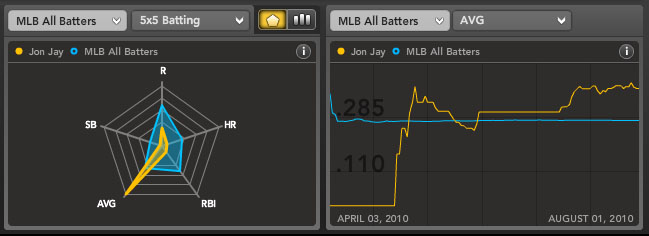 At first blush, everything seems to rule in favor of Jay’s ability to stick. Looking at the Bloomberg Sports Fantasy Tools spider graphs, he looks like he has power, and the strong batting average helps. A .366/.415/.553 batting line should play on any fantasy team. Even a summary check of his minor league numbers this year (.321/.394/.491) would pass inspection. It’s a heckuva fast start.
A longer look, though, takes some the shine off Jay’s profile. Jay’s batting average on balls in play is an astronomical .424; even the two biggest outliers last year, David Wright and Ichiro Suzuki, had .394 and .384 numbers in 2009. Also, BABIP stabilizes at .300 around baseball every year. So you’ll see Jay’s BABIP, and batting average, come down significantly as natural regression sets in.
Then there’s the minor league record that deserves further review. Minor League Splits.com has a translator that creates major league equivalents for minor league numbers. That translation says Jay’s Triple-A numbers in 2010 would work out to .276/.335/.406 in the big leagues. Useful, but hardly as exciting as the stats he’s putting up currently.
A flaw in Jay’s minor league numbers is a poor split against
left-handed hitters (.685 OPS versus southpaws). That split comes in
only 439 plate appearances, so it’s not definitive, but it exists.
Though it may be an issue, the Cardinals did start Jay against lefty Zach Duke over the weekend. Then again, there is a threat coming from Allen Craig as well, who actually sports better numbers against lefties (.900 career OPS versus lefties in the minor leagues) and has his own solid batting line down on the farm (.307/.369/.511). Craig has shown more power in the minor leagues and is a threat to Jay’s playing time, as the justice’s batted ball luck evens out.
Zoom out on the minor league numbers for Jay, and you’ll notice an inconsistent slugging percentage. Just last year, Jay had a .281/.338/.394 batting line with the same Memphis team, numbers which didn’t result in any sort of major league callup. That’s right, Jay was repeating Triple-A this year, which takes his stats down another notch. After three years of college before his pro career, Jay has always been around average age in his leagues, and at both Double-A and Triple-A, he struggled at first before recovering on his second try.
Obviously, Jay is not struggling with his first shot in the major leagues. But you can also see in the numbers that his power is inconsistent, the speed is decent but not elite (he had a career high of 20 stolen bases in Triple-A in 2009), and there is a threat to his playing time on his team. Even as a batting-average specialist, there may or may not be struggles against lefties in his future, and there’s sure to be some BABIP pullback. The ruling of this court is that Jay is a fine pickup in deep NL-only leagues. But in shallower mixed leagues, there are probably better options out there on the waiver wire.
For more on Jon Jay and other outfielders, check out Bloomberg Sports’ Fantasy Tools.
(Video) Ballpark Figures: MLB Trade Reaction, Part 3
By Bloomberg Sports //
Ballpark Figures: MLB Trade Reaction, Part 3 — Bloomberg Television’s Michele Steele and Bloomberg Sports Fantasy Analyst Rob Shaw discuss the latest deals in Major League Baseball. In the third of a five episode series, Shaw focuses on the fantasy value of Dodgers outfielder Scott Podsednik, Tigers infielder Jhonny Peralta, Phillies hurler Roy Oswalt, Astros starting pitcher JA Happ, Padres infielder Miguel Tejada, and Rangers first baseman Jorge Cantu. For more fantasy insight, visit us at BloombergSports.com and Twitter.com/Bloombergsports.
(Video) Ballpark Figures: MLB Trade Reaction, Part 2
By Bloomberg Sports //
Ballpark Figures: MLB Trade Reaction, Part 2 — Bloomberg Television’s Michele Steele and Bloomberg Sports Fantasy Analyst Rob Shaw discuss the latest deals in Major League Baseball. In the second of a five episode series, Shaw focuses on the fantasy value of former Pirates closer Octavio Dotel and what a move to the Dodgers means for him, why Jake Westbrook should become a valuable hurler for the Cardinals, how Ted Lilly should peak with the Dodgers, and why Ryan Theriot’s fantasy value peaks now that he plays every day for the Dodgers. For more fantasy insight, visit us at BloombergSports.com and Twitter.com/Bloombergsports.
Closing Time in Pittsburgh
by Eno Sarris //
When Octavio Dotel took his bag
of strikeouts west to Los Angeles, he left an open question in his
wake: Who will close in Pittsburgh? For once, there are two almost
equally qualified options in the bullpen.
The Bucs have made their initial choice Tuesday night, tapping big right-hander Joel Hanrahan to close out a 7-6 win over the Reds. Hanharan looked good in securing his first save of the season, allowing one hit, no runs, and striking out two.
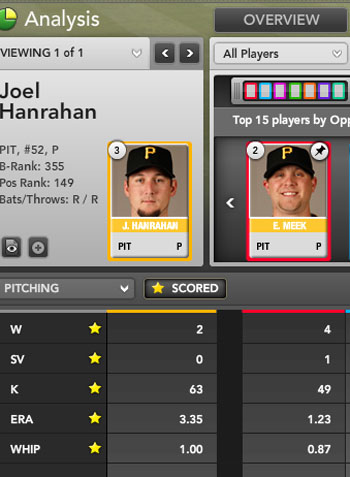 Still, there’s enough mix-and-match potential here for two Pirates pitchers to be worth a look in standard mixed leagues. Do a side-by-side comparison using the Bloomberg Sports Fantasy Tools, and you’ll see that both Hanrahan
and Evan Meek look like perfectly fine options – despite being very different
pitchers. Manager Jim Russell’s initial refusal to name a new closer suggests that he might just ride the hot hand. On the other hand, Buster Olney did say the team would install Hanrahan once Dotel was moved.
Meek’s strikeout rate (7.61 K/9 this year, 7.48 career) places him only slightly above league average. However, Meek has showed a solid walk rate (2.83
BB/9 this year), a development in his game that is a tribute to the
Pirates’ minor league coaches, who immediately helped him harness his
arsenal after years of struggling with his control. Not new to Meek’s
game is his elite groundball percentage. His current 54.7% groundball
rate is well above the average 44% groundball rate across
baseball, and near his already high career level too (53.7%).
Hanrahan
is no vomit-taste jelly bean either (as an aside, these beans exist,
and apparently they started with pepperoni pizza and added a citrus
taste, says the Discovery Channel). The man with an Irish name and an
Iowa birth certificate is striking out batters at a career-high rate this
year (12.65 K/9), but given his very strong career rate (10.02), this isn’t a
huge surprise. What is a nice surprise is that he’s also stopped
walking people in Pittsburgh (2.64 BB/9 this year, 4.66 career). The
combination has been working well.
The only flaw in his game
might actually make him a better fit at the closer position,
ironically. Hanrahan is more of a strikeout/flyout pitcher, with a
below-average groundball rate (35.8% this year, 37% career). Because
groundballs can lead to double-plays, it might behoove the Pirates to
use Meek in situations where there are runners on as a way to
leverage his talents best. Because flyballs can lead to home runs, it
makes sense to at least start Hanrahan off without any runners on.
Coincidentally, this is usually how closers work.
The last piece
of evidence we can use is the two pitchers’ past usage patterns. Hanrahan has owned
the eighth inning for a couple weeks now, while Meek has had the
seventh, with some stints that spanned multiple innings. Most signs
seem to point to Hanrahan, so if you only have one spot to dedicate to
speculating on Pirates’ saves, he’s the man to pick up.
For more on other bullpen situations, check out Bloomberg Sports’ Fantasy Tools.
(Video) Ballpark Figures: MLB Trade Reaction, Part 1
By Bloomberg Sports //
Ballpark Figures: MLB Trade Reaction, Part 1 — Bloomberg Television’s Michele Steele and Bloomberg Sports Fantasy Analyst Rob Shaw discuss the latest deals in Major League Baseball. In the first of a five episode series, Shaw focuses on the fantasy value of Twins closer Matt Capps and what to make of Jon Rauch. Shaw tells us what joining the White Sox means for Edwin Jackson, and provides analysis on the latest Yankees trio Kerry Wood, Austin Kearns, and Lance Berkman. Finally, Shaw tells us that Rick Ankiel will likely never be an everyday player now that he joins the Braves. For more fantasy insight, visit us at BloombergSports.com and Twitter.com/Bloombergsports
(Audio) Behind the Numbers w/ Big League Stew’s Kevin “Duk” Kaduk
By Bloomberg Sports //*
Listen now! – (loads in new browser – 28 megs)
Behind the Numbers
Hosts: Rob Shaw and Wayne Parillo
Guest: Kevin “Duk” Kaduk
About the Guest:
Yahoo.com’s Big League Stew’s Kevin “Duk” Kaduk editor/contributor talks the difference between Yahoo and ESPN, lots of Cubs, and how not to overpay for Cubs tickets.
Enjoy the podcast and make sure to follow him on twitter
Total Running Time: 28:28
The High Level Look
- The rise of Yahoo sports new & how it is different from ESPN (1:00 – 5:23)
- Cubs Signings & Derrek Lee (6:45 – 9:20)
- The Prospects & Cubs Future (11:35 – 14:10)
- The Hawk and other Hall of Famers (18:00 – 23:00)
- Why this season is so great (23:01 – 27:54)
20 Great Duk Moments in this Podcast
Direct link to the conversation
More ways to get Behind the Numbers, talk to us, or just have a good time
- RSS feed
- on iTunes
- Follow us on twitter: Bloomberg Sports, Rob Shaw, or Wayne Parillo
- Play Batter’s Box
- What we have for fans
The Bravest New Pair
By R.J. Anderson //
One of the final trades made before the deadline involved Kyle Farnsworth and Rick Ankiel heading to the Atlanta Braves in exchange for three players. The Braves hope these two help as they march toward the playoffs – could the same hold true for your NL-only fantasy team? Let’s take a look.
Farnsworth
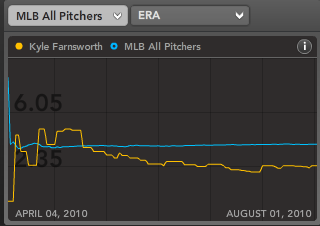
The long and the short of this one is no. Farnsworth’s superficial number in Kansas City looked much better this year (2.42 ERA) than in 2009 (4.58 ERA). But those numbers are deceiving. Farnsworth has posted big drops in his walk (3.38 BB/9 IP in 2009 to 2.42/9 IP in 2010) and home run rates (0.72 to 0.40) this season. But he’s also seen his strikeout rate take a dive (10.13 to 7.25), while benefiting from a lot of good luck: His home runs per flyball rate has plunged to a career-low 4.5% (career average 11.6%), while his strand rate spiked to 80.8% (career 72.9%).
Meanwhile, the Braves’ pen is already well stocked. Billy Wagner, Takashi Saito and Peter Moylan are all ahead in the pecking order for save or even hold opportunities. Effectively, Fanrsworth is coming to Atlanta to take the role of a middle reliever. There are better options out there in NL-only leagues, even among the ranks of non-closer relief pitchers.
Ankiel
Ankiel has put up a mediocre line of .253 AVG/.314 OBP/.453 SLG, with four homers in 105 plate appearances. That’s right on par with his previous National League experience, when he hit .251/.311/.452 with the Cardinals. That’s what Ankiel is: a decent power hitter without much in the way of contact, on-base skills, or stolen base skills who’s also a below-average defender.
Ankiel takes Nate McLouth’s position, after the incumbent center fielder got sent down following a stint on the disabled list with a concussion. Ankiel should be batting somewhere in bottom five of the Braves lineup, which makes him a decent bet for some run production. If you play in a league where positions are counted, then Ankiel has some value in center fielder. Even in standard National League-only leagues, he’s worth a look. Don’t expect the next coming of Jason Heyward and you should be fine.
For more on Rick Ankiel and Kyle Farnsworth, check out Bloomberg Sports’ Front Office
Lance Berkman in the Bronx
By R.J. Anderson //
One of the weekend’s biggest trades brought Lance Berkman to the New York Yankees from the Houston Astros for two minor leaguers. Berkman was in the lineup on Saturday night; batting second while starting at DH. That seems to be the lineup slot and position he’ll likely man during his tenure in New York. Does that make him an attractive option in AL-only leagues?
Berkman’s switch-hitting ability meshes well with the rest of the Yankees’ lineup, which features three other switch-hitters in Nick Swisher, Mark Teixeira, and Jorge Posada. Throughout his career Berkman has hit righties better than lefties, however. With a sky-high .307 AVG/.423 OBP/.591 SLG versus righties, but just .262/.366/.415 vs. lefties. The good news for current and potential Berkman owners is that he’ll be spending a lot of time batting from the left-handed batters’ box, meaning the short porch in Yankee Stadium’s right field could be in play often.
It’s easy to look at his career interleague numbers (which feature a .295/.390/.511 slash line with 30 home runs in 711 plate appearances) and assume he’ll continue to hit that well in the AL. The reality is, those numbers are meaningless. Berkman has been playing baseball in the majors since 1999. He’s appeared in nearly 1,600 games. He has 6,720 career plate appearances. To separate 711 over a span of 12 seasons and assume they’re meaningful doesn’t make sense. He may have faced more weak teams than strong teams and played in friendly hitting environments on the road, or had other factors skew his performance. He’s also past his prime at this point, making some of his peak performance look dated.
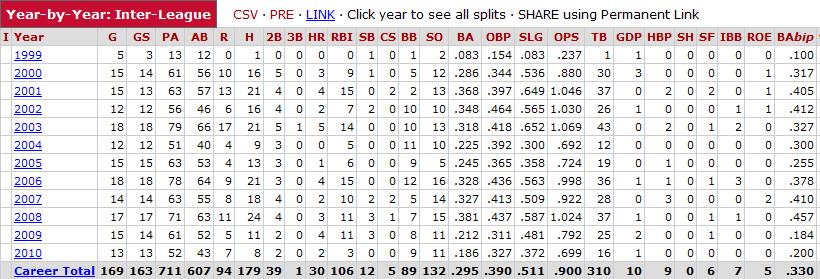
Graphic courtesy of Baseball-Reference.com
What we know is that the level of competition in the American League East far outweighs that of the National League Central. It would be nonsensical to assume Berkman’s projected performances couldn’t slip based on competition alone. The move into Yankees Stadium will help. Being surrounded by great hitters will help when it comes to scoring runs. But there is no guarantee he will light up the league.
That doesn’t mean he’s not worth your time. With the deadline passed, you might as well break your free agent acquisition budget. But if you’re looking to give our offense a big lift, consider making a trade or two to augment the size of your potential offensive boost.
For more on Lance Berkman and his new team, check out Bloomberg Sports’ Front Office
Rangers Acquire Jorge Cantu
By Tommy Rancel //
Chris Davis just can’t win. After starting the season as the Texas Rangers’ first baseman, Davis lost his job to top prospect Justin Smoak. Once Smoak was traded to the Seattle Mariners for Cliff Lee, Davis once again became the Rangers’ starter. That has come to an end (again) with Thursday’s acquisition of Jorge Cantu for two minor league pitchers.
You can feel bad for Davis if you want, but the truth is the Rangers are justified in looking for an upgrade – even a marginal one. In 113 plate appearances, the 24-year-old was hitting just .188/.265/.267. After smashing 21 home runs in 113 games last season, Davis is homerless in 2010.
Jorge Cantu should not be confused with a savior at the position, but even in a down year he has been more productive than Davis. Spending most of his time at third base for the Marlins, Cantu hit .262/.310/.409 in 97 games.
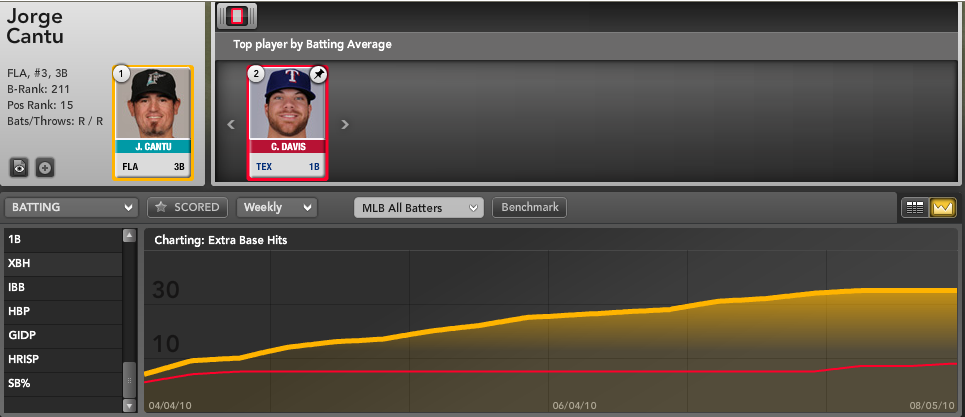
While he is new to the American League West, Cantu has had success in the AL before. As a member of the Tampa Bay Devil Rays in 2004-2005, he hit .289/.318/.507 with 30 home runs and 134 RBI. His peak for Tampa Bay came in 2005, when he hit 28 home runs and drove in a then-team record 117 runs. The next two years were not so productive for Cantu and by mid-2007, the D-Rays traded him to the Cincinnati Reds. After an uneventful half-season in Ohio, he returned to Florida, but this time with the Marlins
Cantu proved to be a solid pickup for Florida. In 2008 and 2009, he combined to hit .283/.336/.462 with 45 home runs and 195 RBI. As mentioned above, this year has been a bit of a downer, but he still has 10 home runs, 25 doubles, and 54 RBI.
One thing that may help Cantu in Texas is the ball park. According to statcorner.com, the Marlins’ Sun Life Stadium is a below-average home run park for right-handed batters. Meanwhile, Rangers Ballpark in Arlington is much more homer-friendly to righties.
Cantu is worth a shot in all AL-only leagues. In a standard 12-team mixed league, Cantu is a borderline pickup, unless you’re in need of a quick fix at a corner infield spot.
For more on Jorge Cantu and his new team, the Texas Rangers, check out Bloomberg Sports’ Front Office
Happ in Houston
by Eno Sarris //
J.A. Happ (pronounced ‘Jay’) is headed south as the centerpiece of the Roy Oswalt deal. Should fantasy owners be interested in the player who is available in 62% of Yahoo leagues?
Judging solely based on ERA, the answer would be in the affirmative. Happ has a 1.73 ERA so far this year, put up a 2.93 ERA last year, and sports a 3.11 ERA for his career. Check, check and check, right? Not so fast – and judging from his availability, it seems most fantasy players these days are savvy to the limitations of ERA for predicting future ERA.
Looking at Happ’s underlying statistics, there are plenty of reasons to worry about him in Houston. Just a peek at his 2010 strikeout rate (5.28 K/9) and walk rate (7.04 BB/9) alone should send the proverbial shiver down the spine. Happ has had some trouble finding the strike zone all year, as he walked 4.1 per nine on his rehab stint too. Granted, he’s pitched only 15.1 innings this year.
Then again, this wildness is not typical of Happ’s career to date, and we also know that walk rates take a while to stabilize (550 batters faced). Happ’s career walk rate is 3.48 BB/9, which is about average (3.33 BB/9 is average this year). The problem is more his lack of a great strikeout rate (6.59 K/9 career, MLB average is 7.03 K/9 this year) or groundball rate (36.5% career, 44% is league average). This package adds up to a mediocre career xFIP (expected fielding independent pitching, a number that strips out batted ball luck, home run luck and other factors, and produces a number on the ERA scale) of 4.65. Happ did put up a 9.2 K/9 in the minor leagues, but until he shows an improved number in that category in the major leagues, we’ll have to go with what we see.
Some analysts might talk about Happ’s move to Minute Maid Park as a reason to avoid the pitcher – and the park does boost home runs for lefties 6% and righties 18% – but that move will actually be a positive one for him. The Phillies’ home park boosts home runs 16% for lefties, and 22% for righties.
Really, given the fact that he’s got an average walk rate and below-average strikeout and groundball rates, there is limited upside for Happ, despite his pristine career ERA to date.  You might even call the Bloomberg Sports Fantasy Tools projection on the right (3.82 ERA, 1.34 WHIP) a rosy scenario for his future. He’s best left on the wire in standard mixed leagues.
For more on other trade deadline movers, check out Bloomberg Sports’ Fantasy Tools.
 Bloomberg Sports