Category: Dailies
Rays’ Jeremy Hellickson Gets the Call, Again
By Tommy Rancel //
Jeremy Hellickson may have been an effective major league starter had he cracked the Tampa Bay Rays’ roster on Opening Day of this season. But where an April gig would have been a luxury, Hellickson’s promotion recently became a necessity.
The Rays had a plan for Hellickson. He made a spot start last week and was sent back down to Durham where his workload could be monitored and controlled. Once the rosters expanded in September, they would recall Hellickson and use him out of the bullpen.
Tampa Bay was able to execute the first part of the plan. Hellickson made his major league debut – a successful one – and was immediately returned to Triple-A. However, even the best-laid plans are subject to change. With Wade Davis AND Jeff Niemann experiencing shoulder pain, the Rays had no choice but to bring back Hellickson and use him as a starter, beginning with tonight’s outing against the Detroit Tigers.
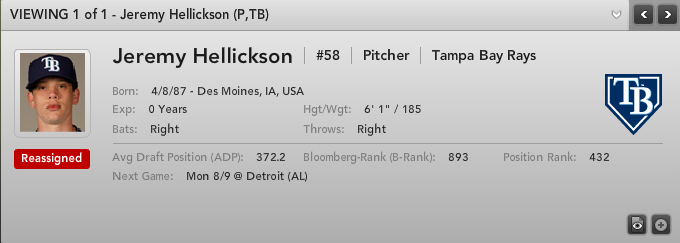
Although he is listed at 6-1 – already on the short side for a right-handed starting pitcher – that might be a generous measurement. Still, the numbers don’t lie. In 578.2 career innings in the minors, he posted 630 strikeouts and just 135 walks. His pinpoint command of the strike zone has drawn comparisons to Greg Maddux. Stuff-wise, Hellickson sets hitters up with his low-to-mid-90s fastball, and puts them away with an excellent change-up and plus breaking ball.
This time around, Hellickson will be on the shortest of leashes. After pitching 114 innings last season, he has surpassed 124 innings this year (117 minor league, 7 major league). Hellickson pitched a career-high 152 innings in 2008. Don’t expect him to go much beyond that this year, if at all.
If that is the case, then we might be looking at five-to-seven big league starts, or possibly just a couple of starts and several relief appearances, if Davis and Niemann get well soon. Still, given Hellickson’s talent and body of work, he’s worth an immediate pickup in all leagues.
For more information on Jeremy Hellickson and
hundreds of other players, and for dozens of tools to help you dominate
your fantasy league, check out Bloomberg Sports’ fantasy kits.
(Video) Ballpark Figures: Dose of Reality – Dawn of a Pitchers Era
By Bloomberg Sports //
Ballpark Figures: Dose of Reality – Dawn of a Pitchers Era — Bloomberg Television’s Michele Steele and Bloomberg Sports Fantasy Analyst Rob Shaw discuss what appears to be the dawning of a pitcher’s era. Shaw explains why he believes we’re seeing so many dominant performances and then speaks to several All-Stars to get their take on the recent trends. Among the players Shaw speaks with are Cardinals ace Adam Wainwright, Marlins ace Josh Johnson, Yankees legend Derek Jeter, Yankees rising star Phil Hughes, and Yankees veteran ace CC Sabathia. For more fantasy insight visit BloombergSports.com.
Yorvit’s Average Batting Average Spree
By R.J. Anderson //
It’s only reasonable that whenever a player goes from one of the best hitting environments in baseball to one of the worst, the expectations for his offensive performance should move down. Evidently, Yorvit Torrealba disagrees with the premise. The 31-year-old backstop spent the last four seasons playing in the Colorado Rockies’ hitter-friendly haven Coors Field, before signing on to play in the San Diego Padres’ pitcher paradise, Petco Park. Yet Torrealba is in the midst of a career year.
Torrealba’s career line with the Rockies, an aweless .258 AVG/.316 OBP/.394 SLG, falls into line with the five-year total he produced with the San Francisco Giants (.251/.318/.393). This year, he’s at .317/.381/.400. Before hounding on how unlikely this development is on so many levels (age, position, park, etc.) take a look at how players who spent time in San Diego and Colorado fared offensively (minimum: 150 AB with each team).

This is an imperfect set of comparisons because age isn’t taken into consideration whatsoever. It does a decent job, though, in illustrating that no matter the year, moving from Colorado to San Diego is less conductive to batting average increases. Of those 11 players, only four saw their batting average go up transitioning to San Diego, and the highest gain stands at a seven-point increase. Torrealba’s average is up more than 60 points.
Beyond the ballpark, look at Torrealba’s age and position again. Only Ivan Rodriguez, Javy Lopez, and Mike Piazza have topped Torrealba’s average since 2000 while being between 30 and 32 years of age. It’s incredibly rare for an older catcher to have his career best season. They generally age poorly at the plate, hence why most of the good offensive catchers, like Piazza and Johnny Bench, move away from backstopping as they age.
A few root causes to note: career-high .373 batting average on balls in play (mostly luck – his career line is .304), and a drop in K rate to 16.6% (career mark is 19.2%). Still, most of Torrealba’s unexpected production is probably just the usual noise associated with a small sample of just 226 plate appearances. In an NL-only league, especially one that rosters two catchers per team, Torrealba’s fine to hold. Otherwise, no need to give him a second look.
For more information on Yorvit Torrealba and hundreds of other players, and for dozens of tools to help you dominate your fantasy league, check out Bloomberg Sports’ fantasy kits.
It’s Time To Trust Brett Myers Again

(Video) Ballpark Figures: Stock Report
By Bloomberg Sports //
Ballpark Figures: Stock Report — Bloomberg Television’s Michele Steele and Bloomberg Sports Fantasy Analyst Rob Shaw go over the Bulls and Bears in Fantasy Baseball. Shaw says it’s a good time to buy low for Astros infielder Chris Johnson and Rays outfielder Matt Joyce, while Andruw Jones and Jeremy Guthrie should not be depended upon for fantasy value. For more fantasy insight, visit us at BloombergSports.com.
The Hidden Value of Seth Smith

Closing Time in Washington
by Eno Sarris //
We already talked about what happened in Octavio Dotel’s wake in Pittsburgh. Now it’s time to examine the new closer situation in D.C.
Matt Capps left for Minnesota and left an open job behind him. It’s not entirely clear who will assume the mantle there, though there is an early favorite. Drew Storen is thought to be the guy to become the closer in Washington, because he was drafted in the first round and was given the title of Closer of the Future. Was the hype warranted?
Yes and no. The no first: Storen is not currently showing any elite results. His strikeout rate (7.62 K/9), walk rate (3.84 BB/9) and groundball rate (37.9%) are all below average. He does have what might be described as a ‘closer’s arsenal,’ with a 94.5 MPH fastball, an 84.4 MPH slider, and an 82.5 MPH curveball. All three pitches rate as net positives according to the Pitch Type Values at FanGraphs.com, which use changes in the state of a game to evaluate each type of pitch. It’s also important to remember that Storen is only 33 innings into his major league career, and had a double-digit strikeout rate in the minor leagues (10.7 K/9).
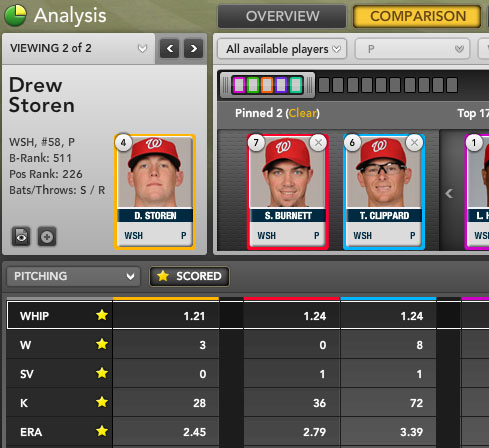 Elsewhere, Tyler Clippard has finally turned a nice strikeout rate from the minor leagues (9.2 K/9 career, with most of it starting, higher as a reliever) into good numbers in the major leagues this year (10.18 K/9). On the other hand, he has a scary walk rate, both this year (4.24 BB/9) and for his career (4.80 BB/9). Also, if Storen is a slight flyball pitcher (and this at risk of giving up deadly home runs) Clippard is ridiculously so (55.1% flyballs this year, 56.3% for his career).
Last but not least is the man that actually garnered the first post-Capps save: Sean Burnett. Burnett has no obvious flaws – his strikeout rate (8.38 K/9), walk rate (3.26 BB/9) and groundball rates (56.6%) are all better than average for a reliever, and passable for a closer. On the other hand, there’s the fact that his career rates (6.05 K/9, 4.17 BB/9 and 52.6% groundballs) are all below his current performance. Also worth noticing is his handedness. Southpaws are sometimes shunned by managers when it comes to picking a closer – there are only two lefties in the top 25 in saves right now. It probably has to do with the fact that lefties are more often used as specialists. Burnett’s platoon splits are also troublesome: In his career, he has struck out 11.15 per nine innings against lefties, but only 6.56 per nine against righties.
This is not an open-and-shut case. Storen doesn’t have the obvious flaws that Clippard does, and he also doesn’t have the platoon split that Burnett has shown so far. Those factors, plus Storen being the 10th pick in the draft and thus someone the club would more likely lean on, make him the man to pick up. Burnett may steal the odd save when a lefty-heavy lineup comes up in the ninth, but Storen should get most of the Nationals’ saves for the rest of this season, and in future seasons.
For more on Drew Storen and other closer candidates, check out Bloomberg Sports’ Fantasy Tools.
(Video) Ballpark Figures: MLB Trade Reaction, Part 5
By Bloomberg Sports //
Ballpark Figures: MLB Trade Reaction — Bloomberg Television’s Michele Steele and Bloomberg Sports Fantasy Analyst Rob Shaw shift the conversation from the players who were traded to the players who will now enjoy an opportunity to play everyday now that spots have opened up after the trade deadline. Shaw focuses on the fantasy value of Diamondbacks hurler Daniel Hudson, Indians outfielder Shelley Duncan, Indians closer Chris Perez, and Astros first baseman Brett Wallace. For more fantasy insight, visit us at BloombergSports.com and Twitter.com/Bloombergsports.
(Video) Ballpark Figures: MLB Trade Reaction, Part 4
By Bloomberg Sports //
Ballpark Figures: MLB Trade Reaction — Bloomberg Television’s Michele Steele and Bloomberg Sports Fantasy Analyst Rob Shaw shift the conversation from the players who were traded to the players who will now enjoy an opportunity to play everyday now that spots have opened up after the trade deadline. Shaw focuses on the fantasy value of Royals outfielder Alex Gordon, Indians infielder Jayson Nix and Andy Marte, Orioles utility man Ty Wigginton, Marlins rookie Logan Morrison, and Nationals soon-to-be-closer Drew Storen. For more fantasy insight, visit us at BloombergSports.com and Twitter.com/Bloombergsports.
Ted Lilly in Los Angeles
 Bloomberg Sports