Category: Dailies
More Fantasy-Relevant Prospects on the Way?
by Eno Sarris //
Last week, we started going down Baseball America’s mid-season Top 25 list looking for prospects who might actually accrue some significant playing time in the major leagues this year. Though the risk with all prospects getting their first shot at the bigs is significant, the upside is also very enticing. Staying on top of these players may be a boon to your team, especially if your league standings are close enough to be impacted by a big final six weeks.
Eleventh on Baseball America’s list is a very interesting name that dovetails with a piece R.J. Anderson just penned. Michael Pineda is a great prospect in the Mariners organization, the team is playing for next year, and Seattle recently traded away Cliff Lee, so it would seem that there might be a place for Pineda. Unfortunately for Pineda, David Pauley was the one who got the call first. But the fact remains that the fifth starter for the Mariners right now, Luke French, owns a poor 59/39 K/BB ratio in 100+ major league innings. French also owns underwhelming rates in the minor leagues (MiLB career 5.8 K/9, 2.7 BB/9), so he could leave the rotation at any time.
 If he does, Pineda could immediately become the newest impact pitching prospect, and an immediate pickup in most leagues. Right now, he’s putting up 8.9 K/9, 1.9 BB/9 and a 2.40 FIP in Triple-A, and that’s the worst strikeout rate he’s shown since he was 18 and in rookie ball. At 21, he’s always been precocious for his league, and the only (very slight) blemish on his record is a groundball percentage that has fallen slightly as he’s advanced levels. Still, at 43.4% right now, and 45.7% career, he could be fine. Just look at Tommy Hanson, who put up similar groundball rates (actually lower) in the minors, and is doing well with a 40% rate in the majors. Bryan Smith took a look at the evolution of groundball rates on FanGraphs recently, and it seems that the takeaway is that it’s not certain that Pineda will have the same struggles as flyballer Brian Matusz in Baltimore, just because they both had similar groundball rates in Triple-A. In fact, Bryan Smith provided this quote when asked about Pineda’s groundball rate: “It’s a normal trend for a right-handed power pitcher.”
It’s also worth noting that Pineda plays in a home park that suppresses home runs on flyballs, and that few teams can match the Mariners great outfield defense. Watch for his pickup and pounce if you need pitching.
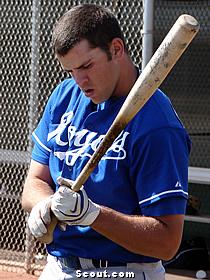 Next on the list is the Kansas City Royals’ Mike Moustakas, who has had a roller-coaster minor league ride. You might consider him in a dip right now, with a .266/.285/.432 battling line in Triple-A Omaha. But if you use MinorLeagueSplits.com to neutralize that line for bad luck (such as on balls in play) and park effects, it looks a lot nicer at .317/.333/.496. Moustakas once hit a trough like this before, as a 20-year-old in High-A ball (.254/.303/.432), but once again his adjusted line was much more palatable (.288/.334/.495). It looks like he runs into some park- and luck-created problems every once in a while, but the power has been there all along.
Two things you will notice when looking over his minor league record are his power and plate discipline. His isolated power for his minor league career is .209, which is already solid; it was an even more impressive .279 at Double-A last year, so his peak power is well above-average. The other thing you might notice is that he doesn’t walk much. His 7% rate in the minor leagues got as high as 8.7% in Double-A, but after the usually inevitable drop in the major leagues, he may not be a great option in leagues that use OBP. Given his intermittent struggles in the minor leagues – luck-oriented or not – Moustakas may also not take the league by storm in his debut. He makes for a better keeper league choice than short-term pickup.
For more on Michaels Pineda and Moustakas and the rest of the top prospects in baseball, check out Bloomberg Sports’ Fantasy Tools.
(Video) Bloomberg Sports’ Ballpark Figures: USA Today’s Steve Gardner
By Bloomberg Sports // Ballpark Figures: Stock Report– Bloomberg Television’s Michele Steele and Bloomberg Sports Fantasy Analyst Rob Shaw are talking baseball. For the details surrounding the K-Rod Mets saga, Jim Thome’s power display, the injured second base superstars, and Josh Willingham and Jacoby Ellsbury, Bloomberg Sports brings on USA Today baseball columnist Steve Gardner. For more fantasy insight visit the Fantasy Windup at USAToday.com as well as BloombergSports.com for your top notch data analysis.
Will Aroldis Chapman Help Your Fantasy Team This Year?
by Eno Sarris //
Continuing an ongoing series here, today we will look at another prospect from Baseball America’s midseason Top 25 list who may come up and impact your fantasy league.
Just this January, Aroldis Chapman agreed to a six-year, $30.25 million contract with the Reds, amid legendary tales of velocity and dominance from the Cuban leagues. Even while signing he was described as ‘raw,’ despite being 22 years old – or roughly the age of a guy a year out of college. The team talked of refining his delivery and not rushing him, but after a good spring training, they assigned him to Triple-A and the countdown began.
True to his age, Chapman was ready for the upper levels of the minor leagues, as his 11.01 K/9 attests. But true to his unrefined label, Chapman also has had his struggles, as his 4.9 BB/9 can attest. In some ways, he fits the statistical profile of Edinson Volquez, his future partner in the Reds’ rotation. He throws gas, is a little wild, and is not a groundball pitcher (41.5% at Triple-A right now), much like Volquez.
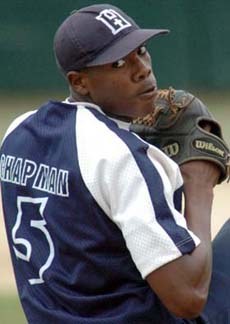 It’s hard to see if Chapman will develop control. He had 365 strikeouts and 203 walks in 327 Cuban innings, a 5.6 BB/9 that was a harbinger of his current struggles. That sort of wildness will limit his upside for sure, but gas like he throws will allow him to persevere as well.
We might look to Brandon Morrow for a true comp.
Though he is a right-handed pitcher, Morrow posted a 4.3 BB/9 in the minor leagues, and owns a 5.14 BB/9 so far in the major leagues. It’s taken him until
this year to fully harness his arsenal (his 10.4 K/9 is helping) to the
point where he has gotten his FIP (3.28) under four for the first time. If Chapman can continue to whittle that walk rate down to the mid-fours like Morrow, he might be okay.
But there are myriad reasons to be skeptical. First, Chapman’s walk rate this year dwarfs even Morrow’s – and Morrow had a BB/9 closer to four at Triple-A before it skyrocketed in the major leagues. Second, only eight pitchers in baseball that have a BB/9 over four are currently qualifying for the ERA title. In other words, only eight pitchers have had enough stuff to overcome such a terrible walk rate to survive as full-time rotation members so far this year. The odds are stacked against Chapman becoming a dominating pitcher even now that he’s shown his strikeout ability in the States.
Morrow is a prescient comparison because Chapman is currently a reliever, much like Morrow used to be while in Seattle. The Reds converted their big Cuban asset, at least temporarily, to relief, and he’s closing in Triple-A. It may have been a move to get him on the major league roster, and with Francisco Cordero currently struggling (4.47 FIP, 5.80 BB/9), it may even mean a fantasy-relevant role will come Chapman’s way when he’s called up as roster expand Sept. 1. (One piece of good news is that his control has been better in relief, with his walk rate down to 4.15 BB/9.)
Because of his still-existent control problems, however, fantasy owners in mixed leagues should wait for concrete news on the subject before moving. Deeper league managers looking for saves could speculate with Chapman. But you’d have to think that Nick Masset (3.77 FIP, 9.6 K/9, 4.07 BB/9) is the next man in line for saves in that bullpen, especially with the Reds in prime playoff contention.
It looks like fantasy owners may have to wait another year to benefit from Chapman’s booming fastball.
For more on Aroldis Chapman and other potential pitcher pickups, check out Bloomberg Sports’ Fantasy Tools.
Arizona Diamondbacks’ New Man: Dan Hudson
By Tommy Rancel //
Before the July 31 non-waiver trade deadline, the Arizona Diamondbacks made a series of moves geared toward their future. One move in particular not only has potential for future reward, but is bringing back some results right now.
In terms of real-life analysis, the thought process behind the Edwin Jackson for Dan Hudson trade was to give up a year and a half of Jackson for six seasons of Hudson. Jackson is a talented pitcher, but he’s on his fifth major league team before the age of 27. He’s a nice piece at the back end of the rotation, but will make more than $8 million next season. Hudson may not have the raw ability that Jackson does, but he will earn around the league minimum for the next few seasons, likely for similar production.
After spending the 2008 season at the rookie level of the minor leagues, Hudson blew through all levels of the White Sox system in 2009 – earning a call-up to he majors after starting the year in low-A ball. He began 2010 at Triple-A, where he continued to post fantastic numbers – especially in the strikeout category. In 93.1 innings, he struck out 108 batters while walking just 31.
Hudson would make three unimpressive starts for the White Sox big club this season before the trade to Arizona. Again, while the move was made with the future in mind, Hudson has provided the Diamondbacks with favorable results in the present.
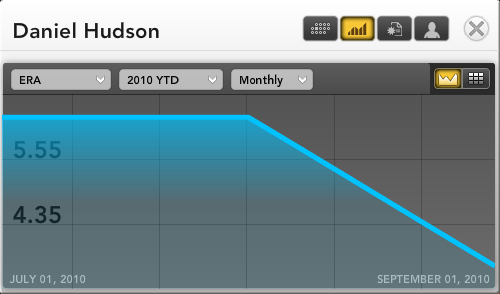
After four turns through the Arizona rotation, the 23-year-old right-hander is 3-1 with a 2.12 ERA. Hudson has struck out an impressive 27 batters in 29.1 innings with the D-Backs, while handing out just four walks.
One concern about Hudson, a flyball pitcher, moving to Arizona is home runs allowed. Chase Field is among the league’s friendliest home run parks. Since moving out west, Hudson has allowed four home runs (1.21 HR/9), and other Arizona pitchers in larger sample sizes have shows home run-heavy tendencies, so it is something that needs to be monitored long-term.
His current swinging strike percentage of 11% shows that his stuff thus far has been good enough to miss the bats of major league hitters. This is good news for his above-average strikeout rate, indicating that it’s more likely to be sustainable. Although he might be prone to the long ball, Hudson has kept the opposition off base in other ways, limiting the damage of the big fly.
Hudson is currently available on the waiver wire in most leagues. If you have the opening, the risk of claiming him is well worth the potential reward of adding an above-average starter as you head toward your fantasy playoffs – especially in deeper leagues.
For more on Daniel Hudson and other late season pick-ups, check out Bloomberg Sports’ Fantasy Kits.
Save Opps: Hisanori Takahashi
Takahashi is being picked up in many leagues with tight saves races. Can he keep the job?


(Video) Bloomberg Sports’ Ballpark Figures: Stock Report
By Bloomberg Sports // Ballpark Figures: Stock Report— Bloomberg Television’s Michele Steele and Bloomberg Sports Fantasy Analyst Rob Shaw discuss the Bulls and Bears in fantasy baseball. Shaw tells us that while Francisco Rodriguez comes out a loser, his replacement Hisanori Takahashi is shooting up in value. Homer Bailey find game earlier this week may be a taste of better things to come. Ryan Raburn is a power bat in the Tigers lineup. Pat Burrell’s bat right now is fool’s gold. Plus, Jason Vargas is a former Mets farmhand in a groove for the Mariners. For more insight follow us at Twitter.com/bloombergsports.
Who in the World is David Pauley?
By R.J. Anderson //
Quick, who replaced Cliff Lee in the Seattle Mariners’ rotation? Nope, not Erik Bedard or Michael Pineda. Try David Pauley. Who? The 27-year-old righty sports a 3.31 ERA through his first 10 appearances this season. With the Mariners already holding two fantasy league sleepers in their rotation this season – Jason Vargas and Doug Fister – could Pauley be the next pitcher to benefit from Seattle’s pitcher-friendly home park and excellent defense? Maybe.
Pauley has bounced around since being drafted in the eighth round of the 2001 draft by the San Diego Padres. Three years later, San Diego traded him to the Boston Red Sox in the Dave Roberts deal, who then sent him to the Baltimore Orioles five years later. After reaching minor league free agency this past winter, Pauley inked with the Mariners, where he probably did not expect to join a rotation stacked with names like Felix Hernandez, Bedard, and Lee. Yet, here he is.
Pauley had only 28 major league innings entering this season, with mixed results. His ERA was awful, and still is, but his underlying peripherals suggested he wasn’t that bad. For instance, his FIP this season is 3.91, whereas his career mark is 4.18. Even with a fastball that sits below 90 (check the chart below, he really does not throw hard), Pauley manages to get a league-average amount of whiffs, thanks to heavy usage of his change-up.

In 85 minor league innings this season, Pauley posted a 3.68 ERA. The last time he flashed an ERA over 4.50 in the minors came in 2006, during his first stint in Triple-A. Since then he’s posted ERAs of 4.33, 3.55, 4.37, and the aforementioned 3.68. Most projection systems have Pauley with a much higher ERA than league average, but that seems harsh considering his ability to get groundballs while pitching in front of a grade-A defense and in a park that restricts power.
That doesn’t mean Pauley is a must-get in your league. He’s hardly that, but he is owned in less than 1% of ESPN leagues. So if you’re in an AL-only or deep mixed league, Pauley is worth a shot.
For more on David Pauley and other potential pitcher pickups, check out Bloomberg Sports’ Fantasy Kits
(Audio) Behind the Numbers w/ Dave Cameron
By Bloomberg Sports //*
Listen now! – (loads in new browser – 22 megs)
Behind the Numbers
Hosts: Rob Shaw and Wayne Parillo
Guest: Dave Cameron
About the Guest:
USSMariner.com co-founder, Fangraphs.com writer, and Wall Street Journal contributer.
Enjoy the podcast and make sure to follow him on twitter
Total Running Time: 21:08
Dave’s Wall Street Journal article we talk about during the podcast
High Level
- Young Pitchers on the Hill & Better Coaching (1:01 – 5:46)
- Defense, Baseball, and Situational Relievers (5:47 – 11:17)
- What We Can Predict for Pitchers (12:11 – 16:21)
- Adrian Beltre MVP, Hall of Famer, and SafeCo (18:04 – 20:24)
- Fangraphs at SafeCo on September 4th (20:33 – 21:07)
Near Highlight a Minute
- (1:01 – 2:04) Why it is NOT the Year of the Pitcher
- (2:24 – 3:20) Are there a young rising stars on the hill?
- (3:20 – 3:51) Why there are bigger, stronger pitchers on the mound
- (3:56 – 4:40) Young pitchers & pin point control
- (4:41 – 5:46) Minor League coaches & teaching wow to pitch
- (5:47 – 6:46) How replacing managers is merely fluction bias
- (6:54 – 8:30) Valuing situational relievers and using situational splits
- (8:31 – 9:16) What it would take for a team to use only situational splits
- (9:17 – 9:45) Educating the pitcher
- (9:57 – 10:49) Defense and baseball – how Mariners have not failed
- (10:50 – 11:17) Why all strategies succeed and fail
- (11:32 – 12:10) Pitchers with ERAs under 3.00 and what it means
- (12:11 – 14:07) Body types, pitching, and what we can predict
- (14:08 – 15:21) How long is a pitcher’s shelf life?
- (15:30 – 16:21) Strasburg v Kershaw
- (16:27 – 17:44) Is Dave a journalist, blogger, or is it all just writing?
- (18:04 – 18:54) Adrian Beltre for MVP and Hall of Famer?
- (18:55 – 19:50) SafeCo and the right handed hitters mentality
- (20:33 – 21:07) Doing an Event at SafeCo During September 4
Direct link to the conversation
More ways to get Behind the Numbers, talk to us, or just have a good time
- RSS feed
- on iTunes
- Follow us on twitter: Bloomberg Sports, Rob Shaw, or Wayne Parillo
- Play Batter’s Box
- What we have for fans
The Value of Jorge de la Rosa
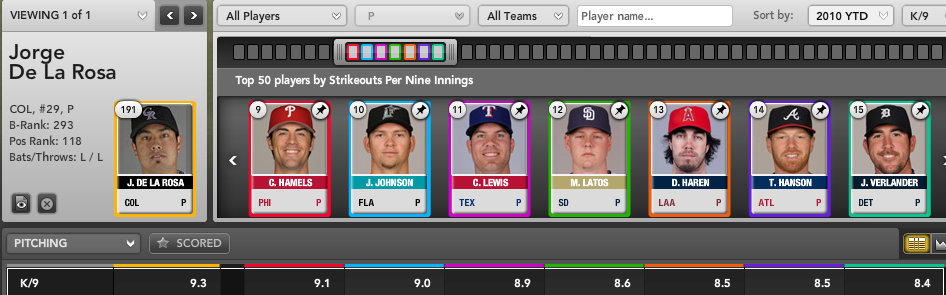
- Team A: 7.30 K/9
- Team B: 7.28 K/9
- Team C: 7.26 K/9
- Team D: 7.24 K/9
- Team E: 7.22 K/9
- Our Team: 7.20 K/9
Jorge de la Rosa’s strikeout rate is 9.24 per nine innings this year. It was 9.39 last year. Bloomberg Sports projects a conservative 8.8 over 55 innings the rest of the year.
Don’t Give Up On Jonathan Broxton
By Tommy Rancel //
Even before his days as the closer for the Los Angeles Dodgers, Jonathan Broxton was among the few relief aces in baseball. In 364.1 career innings of work, Broxton has a strikeout per nine innings rate (K/9) of 11.86, a walk per nine innings rate (BB/9) of 3.56, and a home run per nine innings rate (HR/9) of 0.52. Looking back in major league history, only Broxton and Billy Wagner have pitched more than 340 relief innings with a K/9 more than 11.5, a BB/9 less than 4.0, and a HR/9 less than 1.0.
In 2010, Broxton is doing more of the same. His K/9 is once again hovering around 11.0 (11.41). His BB/9 (3.42) and HR/9 (0.38) are actually less than his career levels. His 2.37 FIP (fielding independent pitching) is the fifth best among National League closers.
Everything is good, right? Wrong.
Just last week, Broxton was removed from his role as the Dodgers’ closer. His overall numbers look stellar, but in recent weeks things have not gone well for the 26-year-old. Since July 1, he has allowed 12 runs on 14 hits – including the only two home runs he has yielded all season. He gave up just eight runs in the first three months of the season. Add in Hong-Chih Kuo‘s impressive numbers (1.95 FIP), and you can’t really fault Joe Torre for making a move. That said, it is not time to jump ship on Broxton.
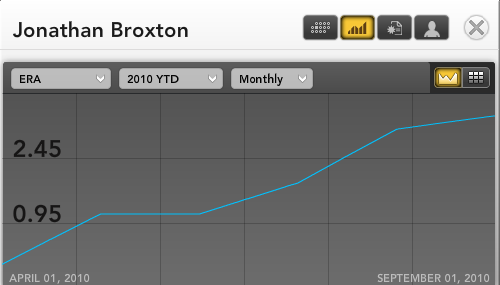
Currently, Broxton owns a 3.42 ERA. That is a full run more than his FIP. That’s largely due to all the additional baserunners getting on with hits. In 46.1 innings this year, he has allowed 44 hits. He allowed 44 hits all of last year in 76 innings. The good news is that of the 44 hits given up in 2010, 34 of them have been singles.
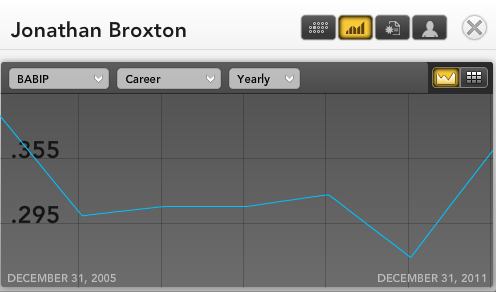
A groundball pitcher (46.1% career groundball rate), Broxton’s batting average on balls in play (BABIP) of .364 is absurdly high. His career BABIP is .325, while the league average is around .300. Even with a career number that is regularly above the league norm, a .364 BABIP is just ridiculous for a guy with Broxton’s stuff.
Speaking of stuff, it seems Broxton’s dominating combo of mid-90s fastball and high-80s slider has been less effective of late. Before July 1, his fastball registered a strike 67.4% of the time; the slider 78.1%. Since then, his strike percentage on the heater is down to 60.5%, and the slider to 67.3%.
If the Dodgers are continuing to use Broxton, they must feel he is healthy. His velocity readings have also remained steady through his struggles. With that said, Broxton’s troubles seem like an easy fix from the outside looking in. Whether it be something mechanical or mental, or maybe just a bounceback in luck, the big righty should rebound at some point. Keep him rostered as a high-strikeout setup man, and hope he wins his closer job back soon.
For more on Jonathan Broxton and his historic rates, check out Bloomberg Sports’ Fantasy Kits
 Bloomberg Sports