Category: Dailies
MLB Season in Review: New York Mets Hitting
By Eno Sarris //
Biggest Surprise
Angel Pagan finally stayed healthy and showed what he was capable of for a full
season, racking up 11 homers, 69 RBI, 77 runs scored, 35 steals and a .289 average with a week left to play. At 29, he’s probably peaking. But another full season of playing time could easily produce similar numbers.
Biggest Bust
Pagan will most likely take over center field from one of the year’s biggest busts, Carlos Beltran. Knee surgery may have stolen much of his athleticism – he
hasn’t looked good this year after his late return. He is, at best, a
late (very late) sleeper in next year’s drafts. Then again, more was
expected of Jason Bay than Beltran, so he gets the title of biggest Mets bust – a much sought after trophy in some circles. Because of how long
isolated power numbers take to become reliable, though, Bay could be useful in
2011. A late-round pick could produce a rebound in homers in year two with the Mets.
2011 Keeper Alert
This team has the obvious keepers in mixed leagues – David Wright and Jose Reyes are near the top of their respective careers and positions and make fine keepers. The big question is what will happen with Ike Davis.
He needs to either add more power or make more contact – middling power
with a middling batting average doesn’t make for a fantasy superstar, especially not at first base.
Looking at his minor league numbers, the bet here is that he does add
the power, but doesn’t ever show a plus batting average because of his
strikeout rate and uppercut swing.
2011 Regression Warning
Funnily
enough, most of this team either hit at about their true talent levels
or is on their way up. Perhaps because of injury risk, Pagan is the
only one who is likely to regress, but he still makes a fine
deep-league keeper.
For more on Mets’ hitters, check out Bloomberg Sports’ Fantasy Tools.
MLB Season in Review: New York Mets Pitching
By Eno Sarris //
Biggest Surprise
The biggest positive surprise in a season full of mostly negative revelations for the New York Metropolitans has been R.A. Dickey. Dickey, the subject of a recent – and fun – poster contest, has leveraged his multi-velocity knuckleball
to a 2.92 ERA and 11 wins so far. Dickey’s 5.36 K/9 IP rate raise red
flags about his future. But he’s also walking just over 2 batters per 9
IP this season, with a very high 55% groundball rate. If he’s truly harnessed his knuckleball, Dickey could become a trickier, more successful version of Joel Pineiro or Jake Westbrook. In other words, someone well worth rostering next season, even as he enters his late 30s.
Biggest Bust
On the other side of the coin would have to be Johan Santana‘s
season. Maybe we should have seen it coming – he’s now had
season-ending surgeries two years running, and his strikeout and walk
rates have been in a nose-dive since he left Minnesota. But the
declining lefty put up a below-average strikeout rate this year, and
has a recovery period that might push late into 2011.
2011 Keeper Alert
Francisco Rodriguez
makes for a paragraph all by himself. K-Rod reversed the decline in his
strikeout rates and showed the best control of his career. He generally
seemed to be a resurgent, elite closer for much of the year. But then
he punched his girlfriend’s father and now makes for a fascinating and
risky keeper selection going into 2011. It’s usually a bad idea to keep
a closer anyway because of the turnover at the position. See if you can
grab him cheap at the draft table instead.
Regression Warning
If Santana, Rodriguez, Dickey and even Dillon Gee have their risks, there are no obvious keepers on this pitching staff. Mike Pelfrey
had a playable season, but he also showed the worst groundball rate of
his career and is a bit of a risk for regression with a poor strikeout
rate. Jon Niese might actually make the best keeper on the staff, but isn’t worth the effort in shallow mixed leagues.
Avoid Mets pitchers when picking keepers for 2011. Instead,
see if you can snag a couple late in your draft next season (Niese?
Dickey?), especially given their favorable home park.
For more on the Mets, check out Bloomberg Sports’ Fantasy Tools
MLB Season in Review: San Francisco Giants Pitchers
By Eriq Gardner //
Biggest Surprise
Jonathan Sanchez got some love in the preseason as a sleeper. There aren’t too many pitchers who can be counted upon to strike out at least a batter per inning. His upside to do more got him drafted in many fantasy leagues. But few would have imagined that Sanchez would sport a 3.16 ERA and 1.22 WHIP with two starts left in his season. Beware, though: Better luck has been the biggest reason for the improvement, with opponents hitting just .266 against him on balls in play (vs. .302 lifetime BABIP allowed, and league average around .300).
Biggest Bust
On the surface, it might seem a stretch to call Tim Lincecum a bust. After all, most pitchers would love to lead the league in strikeouts and have a 3.60 ERA. But some context is in order. Lincecum was the top drafted pitcher in fantasy leagues, as many were expecting the stud who posted back-to-back Cy Young Award seasons with at least 260 strikeouts, a sub-3 ERA, and a sub-1.20 WHIP. This season, Lincecum’s strikeout rate is down, his walk rate is up from 2009 levels (though it’s right at his career average), and he’s nowhere close to award consideration.
2011 Keeper Alert
It’s not always wise to use keeper slots on closers, but Brian Wilson keeps getting better and better and is one of the league’s top relievers now. Not only for the saves and solid ERA/WHIP he contributes, but Wilson is also flirting with 100 strikeouts.
2011 Regression Alert
Madison Bumgarner was a top prospect coming up through the Giants’ farm system. In 16 starts this season, the youngster has posted a 3.06 ERA, including a scoreless outing last night. Everything may seem dandy, but Bumgarner is only striking out 6.71 batters per 9 innings and sports an xFIP more than a run higher than his actual ERA. On the plus side, his walk rate is a low 2.12 BB/9 IP this season. He’s a keeper, but don’t overbid if you’re drafting anew next season.
MLB Season In Review: Pittsburgh Pirates Pitchers
By R.J. Anderson //
Biggest Surprise: James McDonald
No secret to regular Bloomberg Sports blog readers, is a favorite ’round these parts. McDonald is worthy of the endearment thrown his way because of his stellar strikeout rate (8.32 K/9 IP). His playable 4.09 ERA is backed by a 3.19 FIP (Fielding Independent Pitching, a stat that runs along the same scale as ERA but strips out the impact of defense, park effects and other factors beyond a pitcher’s control). McDonald was acquired for a half season of a non-elite reliever, a technique Billy Beane described as “Building a Closer” in Moneyball.
Biggest Bust: Charlie Morton
One of the keys in the Nate McLouth deal, Morton’s 2010 season never opened the Pleasantville gates. Good build and strong velocity make Morton a pitcher scouts like, but his stuff ha yet to translate to strikeouts in the big leagues. After returning from the disabled list, the occasional big strikeout game disappeared too, making him virtually unwatchable. He’s better than the abysmal 8.11 ERA he’s posted this season, but there are many pitchers with a lot more potential, even in deep leagues.
2011 Keeper Alert: James McDonald
McDonald should get his first shot at a 200-inning season next year, which could translate into lots of strikeouts and solid ratios, even if the win total might falter playing for the rebuilding Pirates.
2011 Regression Alert: Paul Maholm
Maholm is a groundball-heavy pitcher who relies heavily on his infield defense taking fieldable balls and converting them into outs. Unfortunately, the infield defense did not do a worthwhile job this season, and thus, Maholm wound up with an ERA over 5. If the Pirates address their hole-filled defense this off-season, expect Maholm to bounce back and make for a nifty sleeper.
MLB Season in Review: Pittsburgh Pirates Hitters
By R.J. Anderson //
Biggest Surprise
Neil Walker stuck around the Pirates’ system for years as their next big catching prospect. For a while, he followed in the footsteps of J.R. House – the last great Pirates’ catching prospect who busted in the minors. But a position switch and depth failure led to Walker getting a chance at the majors this season. He responded by hitting .296 with a dozen homers.
Biggest Bust
Garrett Jones hit 21 home runs in 358 plate appearances last season. He’s hit 20 in 602 this season. His batting average has dropped nearly 50 points. It seems unlikely Jones will enter next season with any kind of assured playing time. Akinori Iwamura fits the bill too, although he is well removed from the Pirates’ organization and resides with the Athletics now.
2011 Keeper Alert
Andrew McCutchen continues to solidify himself as one of the best center fielders in the National League. Posting a .286/.365/.471 slash line as a 22-year-old is hard to top, so he may have disappointed by hitting only .279/.356/.447 this season. But he did manage to cut down on his strikeouts and continues to run the bases and play the field well. Youngster Pedro Alvarez is also worthy of a keep in all but the shallowest leagues.
2011 Regression Warning
Walker is the name here because the rest of the Pirates’ hitters are either legitimately good or awful with little in between and little due to bad or good luck. An elevated .342 batting average on balls in play and more than three times as many strikeouts as walks don’t exactly scream “.296 hitter!”
The Difference Between Carlos Zambrano and Josh Beckett
By R.J. Anderson //
Through the lenses of ERA, Josh Beckett and Carlos Zambrano could not be more dissimilar.
Zambrano sports a sparkling 3.56 ERA this year, with a mark under 2.00 since returning full-time in August. Over his first eight post-return starts, Big Z struck out 45 while allowing only a single home run.
Beckett, meanwhile, has about the same amount of innings with varying results. In August, his ERA was over 6.00 – making it the third of four completed months this season in which that was true – while September has brought with it an ERA below 3.00. For the season, though, he’s still lugging a sky-high 5.71 ERA. Based on those numbers, one might label Zambrano as a keeper and Beckett as someone to pass on. After all, Zambrano appears to be at the top of his game down the stretch.
Things are not always as they seem, though, and that is why looking beyond the surface is vital when tagging players to keep or not. Zambrano is striking out about 1.5 batters per walk; whereas Beckett is striking out nearly four batters per walk.
The difference between the two reveals itself as a matter of home runs allowed. Zambrano’s one blast per 54 innings average is in no way representative of what he will continue to offer, as his career average is one per 12 innings. Beckett has given up a homer every six innings versus his career average of a homer every nine. Because of that, these two will be a lot more alike next season than it appears now. Both are keeper-worthy.
For more on Zambrano, Beckett, and more studly pitchers, check out Bloomberg Sports’ Fantasy Tools.
Emilio Bonifacio and Feeling Dirty
By Eno Sarris //
Sometimes, fantasy managers have to do things that make them feel dirty. They’ll pick up a lousy pitcher who has happened upon the closer role, or grab a streaky player in the middle of a nice stretch. It happens, and it can lead to championships.
That brings us to Emilio Bonifacio and his role on the Florida Marlins this year. With the underwhelming Wes Helms the other option at third base, the speedy infielder has received ample playing time at the hot corner, while also backing up the starting outfielders. He has produced for fantasy owners too, hitting .283 with nine stolen bases in just 166 plate appearances (with three of those steals coming in September). Managers in leagues of any kind could easily get a speed boost from him right now, and they’d be forgiven.
But they’d have to be forgiven nonetheless, because there is a litany of reasons why Bonifacio is not a good long-term option. The most obvious is the fact that he’s not in the team’s long-term plans at any position: last year’s rookie of the year Chris Coghlan is said to be slated for third base next year, and most of the rest of the positions around the diamond are filled with promising young players, like the recently profiled Logan Morrison.
The rest of the reasons might be less obvious but are more damning. For example, Bonifacio doesn’t walk enough for a man with his skill set – his 7.1% career walk rate is below average (usually the league average is around 9%). He also strikes out a tad too much (21.8% career strikeout rate, average is around 20%) for a guy with absolutely no power (.069 ISO, average is usually around .150). In fact, his career strikeout rate would be the worst among batting average qualifiers with ISOs below .100 this year. He’d also be the only player to combine a below-average walk rate with a strikeout rate over 20% and an ISO under .100.
None of this even mentions his unsustainable .352 batting average on balls in play – he is speedy, and might have a higher BABIP than most, but that’s not a number that’s likely to hold. Lastly, Bonifacio rates as a negative defender at all of the infield positions he’s played, which is yet another reason why he probably won’t figure prominently in the Marlins’ plans next year.
Sometimes you have to pick up flawed players on the way to a fantasy title. The important thing is to remember to not drop a player of consequence, and to not keep flawed players from year to year. Even in a deep keeper league, there’s no point in stashing Bonifacio, despite his 30 combined steals in the past two seasons. He is just the kind of player who can give you a few stolen bases in the season’s final weeks, then get discarded in the off-season.
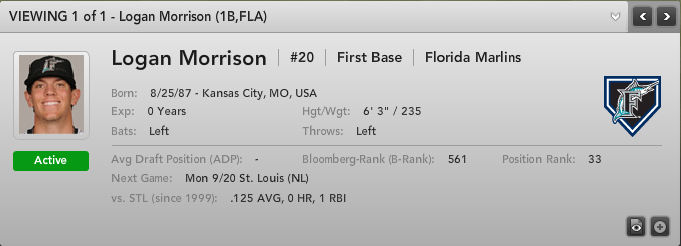
Logan Morrison Takes His Talents to South Beach
By Tommy Rancel //
Although he has the size (6’3″/235) and he plays the positions (first base and corner outfield), Logan Morrison‘s game does not match his size. Still, that hasn’t stopped Morrison from being rated as a top-20 prospect in all of baseball by Baseball America for the past two years.
Morrison, 23, spent most of his minor league career as a first baseman. However, with Gaby Sanchez‘s solid play at first and Chris Coghlan‘s injury leaving a void in left field, Morrison has found a new home with the Marlins – at least temporarily. While his defensive responsibilities have shifted, Morrison is still doing what he does best – hit and get on base.
The Marlins rookie is hitting .310/.427/.492 in 225 plate appearances since getting called up from the minor leagues. With that said, his .310 batting average is largely fueled by an unsustainable .378 BABIP (batting average on balls in play), and he is not likely to carry a .919 OPS over 600 a full season. However, don’t mistake this hot start as just a fluke.
In more than 1900 minor league at-bats, Morrison hit .292/.383/.465. That’s a far cry from his current slash line, but still above-average. As mentioned, Morrison has the look of a hulk-smashing home run hitter, but that’s not a major part of his game – at least not yet. On the other hand, he has shown some solid doubles power, including 38 in 130 games at A-ball in 2008.
Currently, Morrison has a .182 ISO (Isolated Power – slugging percentage minus batting average) despite having just two major league home runs. Lacking the power to put the ball over the wall, he is simply spraying it all over the field. He has already racked up 18 doubles and five triples this year.
In addition to the gap power, Morrison is showing a very good batting eye, with a 16% walk rate. He is striking out 19.8% of the time, but his 20.7% O-Swing (swings at pitches outside of the strike zone) and 6.5% swinging strike percentage show further signs of a solid batting eye.
Because of his extra-base hits and the favorable walk rate, Morrison has already scored 36 runs despite playing in just 48 games.
While his red-hot slash line is not likely to be reproduced in the near future, Morrison looks ready for an everyday spot in the Marlins lineup next season. Whether it comes as a first baseman or an outfielder is unknown. But don’t let that stop you from picking him up right now in NL-only and mixed keeper leagues.
For more on Logan Morrison and potential NL keepers, check out Bloomberg Sports’ Fantasy Kits
The Case Against Carlos Gonzalez
By Eriq Gardner //
Carlos Gonzalez of the Colorado Rockies is having a very charmed season. By season’s end, he’ll have roughly 35 HRs, 25 SBs, 120 RBIs, 110 Runs, and a .340 batting average. These numbers arguably earn him the title as the season’s Fantasy MVP and gain him consideration as one of the top few picks heading into next year. The case in his favor looks strong, at first glance.
But beware. The young stud outfielder carries plenty of risk – and smart fantasy enthusiasts may be wise to stay away.
Let’s start out with the obvious: CarGo has been the beneficiary of tremendous luck this season.
The biggest knock against Gonzalez is his plate discipline. He strikes out 23% of the time and only takes a walk 6% of the time. This has added up to a .389 BABIP, which puts him only behind Josh Hamilton and Austin Jackson among players with regular playing time who have benefited from better luck on balls hit in play. Certainly, we can expect a higher-than-normal BABIP considering Gonzalez’ great speed, but not this high. Expected regression could knock anywhere from 40 to 60 points off that lofty .340 batting average.
As for power, don’t expect 35 HRs again. Yes, he’s the beneficiary of playing in the tremendous hitting environment of Coors Field. But then again, CarGo is rather below-average in hitting for fly balls. His 37% rate is below average, roughly on par with Rajai Davis.or Alberto Callaspo. He’s knocked 35 out of the park this year thanks to the fact that nearly 21% of his fly balls have gone for HRs. Only Joey Votto, Carlos Pena, Jose Bautista, and Adam Dunn sport a higher percentage. At 6’1” and 210 pounds, Carlos Gonzalez carries less body mass than those other four to support such massive power.
Carlos Gonzalez’ great luck in average and power has contributed to him reaching triple digits in both runs and RBIs. The team has another excellent player in Troy Tulowitzki, but the decline of Todd Helton and the departure of Brad Hawpe leaves the lineup dependent on youngsters like Ian Stewart, Dexter Fowler, Eric Young Jr. and Seth Smith to get on base in front of CarGo or reciprocally drive him home. Any slippage in the ability to get on base or knock balls out of the park will erode his ability to post elite context stats in runs and RBIs like the production he’s given this season.
That’s part 1 of the case against Carlos Gonzalez.
All of which might be acceptable but for two more glaring facts about Carlos Gonzalez: First, to put it simply, he’s never done this before. And second, his price tag in fantasy leagues is going to be through the roof coming off such a stellar year.
Yes, he was a very fine prospect coming up through the minors, is only 24-years-old, and is still growing.
Carlos Gonzalez has great upside, no doubt, and deserves to be honored for the season he is enjoying. But once the season completes, none of that matters going forward. The only question is what he’s going to do for an encore. Unfortunately, it seems likely that in drafts and auctions, the price of admission will be too high on this young player at a non-scarce position. Consider yourself warned.
The Pro-CarGo Post
By Eno Sarris //
It’s a little tough to make the case for Carlos Gonzalez next year when you agree with many of the points made by the other side, in this case by Eriq Gardner. A lot of luck on the batted ball does go into most .340 batting averages, and Gonzalez has certainly seen a few balls clear the fence that haven’t before. He probably won’t put up the same season next year, that much we can grant.
But how much will he regress? If he regresses just a little bit, he could still be an outfielder with a .300 batting average and 25+/25+ numbers, which would probably make his owners happy even if they spent an early first-round pick on him.
The .389 BABIP is an eyesore to the sabremetrically-inclined fantasy fan. That number seems like it includes a lot of luck. But we also know that every player has their own ‘true’ BABIP level, based on their unique blend of speed and batted ball mix. Peter Bendix once created an xBABIP calculator to see what an expected BABIP might be, given these factors, and using that calculator we find that CarGo’s xBABIP this year is .349. The difference in hits would be 18 hits if he featured his xBABIP instead of his BABIP, and his batting average would instead be .308 instead of .341. Gonzalez could be a little less lucky and still have a strong batting average next year.
The fact that he is showing the best power in his career doesn’t necessarily mean that he won’t come close again next year. His ISO this year is .270, last year it was .241. In the minor leagues, it was .194 overall, but .291 in his final stop. If he retreats to an ISO between his last two major league numbers, he’ll be in among Mark Reynolds, Troy Tulowitzki, Carlos Quentin and Vernon Wells on the ISO leaderboard. His power likely won’t disappear completely in other words, especially if he still calls Coors Field home, since he has a career .292 ISO in 155 home games.
About his flyballs and the HR/FB rate, those numbers fluctuate from year to year. Last year, he hit 38.8% flyballs, and 16.7% HR/FB. This year, those numbers are 36.9% and 20.9%, respectively. In the minor leagues, his full-year flyball rates fluctuated from 30.7% to 43% at different stops. He could easily hit more flyballs next year, have fewer home runs per flyball, and not see a huge drop in his home run total.
One last note. Gardner mentions the lineup around Gonzalez as a negative, but it seems like more of a positive to this analyst. As Todd Helton and Clint Barmes have declined or shown their flaws, they have lost at-bats to younger players, and Ian Stewart, Dexter Fowler, Eric Young Jr. and Seth Smith all have upside beyond their current levels. Projecting an entire lineup is iffy either way, but let’s just say: Carlos Gonzalez is the number-three hitter for the Colorado Rockies. In 2009, the three-hitter for the Rockies accrued 92 runs and 100 RBI. As long as the offense stays somewhat similar and Gonzalez stays healthy, he will likely approach 100/100 numbers in those categories.
If you pro-rate out CarGo’s 2009 totals to 600 plate appearances – which is problematic considering he only accrued 317 PA, but let’s do this for the sake of comparison – he might have had 25 home runs and 30 stolen bases. Add a batting average close to .300, and you still have a very exciting young player worth a very high draft pick, especially in leagues that break out the outfielder positions and count CarGo as a center fielder.
Gonzalez’s numbers in 2011 might not look like 2010’s gaudy Triple Crown-contending statistics, but the power and speed are real, and there’s little reason to think that next year’s Rockies lineup won’t allow him to accrue 100 runs and 100 RBI yet again. He’s a great keeper and a great first-round investment next year. Auction managers should remember to temper their power expectations when bidding, but otherwise it’s all “go CarGo” here.
For more on Carlos Gonzalez and other power/speed outfielders, check out Bloomberg Sports’ Fantasy Tools.
 Bloomberg Sports