Category: Dailies
MLB Season in Review: Los Angeles Dodgers Hitters
By Eriq Gardner //
Bryce Harper May Not Be Superman
by Eno Sarris //
Scouting is a tough business. There is
no scout superpower that allows members of the profession to leap over
tall buildings and see into the future. Otherwise there would be some extremely well-paid scouts and some bulletproof teams out there.
Instead,
members of the human race are left trying to learn aspects of
successful baseball players, and then look for those aspects in young
prospects. The problem is, you can look great using a metal bat or beating
up on pitchers who can’t locate their fastball and don’t have a
secondary pitch worth worrying about – and yet still fail at the major league level.
Enter Bryce Harper, the #1 pick of the 2010 draft, and current Arizona Fall League wunderkind.
Look at him at the plate thanks to this great video by Joel Henard at Baseball Daily Digest Radio, and you may, like one scout here in Arizona mused, think he has a high-effort swing. There certainly are a
lot of things that have to go right in his swing, even if the best
result is a powerful one. There are scouting mantras
that say swings that can be described as ‘easy’ and ‘loose’ are
the goal. After watching a few more Harper hacks, you might decide that
though it’s high-effort and complicated, his swing does look like it could generate results. You’ll also see how difficult
scouting can be.
Take a look at the list of first-overall picks in the amateur draft and you’ll find some hits and also plenty of misses. For every superhero like Justin Upton and Chipper Jones, there is a superdud like Ben McDonald and Matt Bush. Limit the list to power hitters, however, and it’s a little harder to find busts. If you give Pat Burrell
some credit, and ignore catchers and shortstops who may have been
taken for potential defensive prowess, you might have to go all the
way to Shawn Abner in 1984 to really find a first-pick, power-hitting bust with a capital B. Viewed in that light, Harper’s draft position alone works in his favor.
In
Harper’s case, we even have some mitigating statistics to help us out.
Though he didn’t play in college, he did pick a junior college that
played with wooden bats – and at the tender age of 17, he put up an
astounding .442/.524/.986 line that could get any pessimistic scout
over-ruled. Now he’s playing against some of the best prospects in
baseball at the Arizona Fall League, and once again his .348/.423/.565
(albeit in a small sample of games) seems to answer most questions.
Except there’s one little
thing… he’s struck out eight times in his first 23 at bats (34.7%). The sample size is not close
to being reliable – strikeout rates usually take more than 150 plate appearances to become predictive. Still, one wonders when the first criticisms of Harper wearing
enough eye black to drown Aquaman will start (image thanks to Robert Beck/Sports Illustrated/Getty Images).
Paired with his age, and the odd high-effort
swing, there is a little doubt here. Even if he does work out, it should
take some time (Adrian Beltre‘s 19-year old, 214-plate
appearance, .215/.278/.369 debut was the youngest significant major league start
since 1975; Ken Griffey, Jr. managed a .264/.329/.420 line at a few months older). His future still looks bright, but don’t expect much, if any impact for at least a couple years.
For more on Bryce Harper and other young prospects, check out Bloomberg Sports’ Front Office.
David DeJesus Traded for Vin Mazzaro
By R.J. Anderson //
Although the Athletics and Royals did not agree on the first trade of the offseason, they did pull off most-talked about deal thus far. The details have left fielder David DeJesus heading to Oakland, while starting pitchers Vin Mazarro and Justin Marks go to Kansas City. Marks holds some middle-of-the-rotation upside, but clearly the bigger names here are DeJesus and Mazzaro.
DeJesus is a typical Athletics outfielder, or at least typical of the past few years. He plays good defense, reaches base, and does not hit for much power, while going about his business in an unheralded fashion. DeJesus’ line over the last three seasons is .300/.363/.443 with an average of 14 home runs per 700 plate appearances and eight stolen bases; which is to say he is a much better player in real life than in fantasy.
An extra instance of DeJesus’ value in real life being higher than his fantasy value comes in the form of draft compensation. The soon-to-be 31-year-old projects as a borderline Type A free agent. Meaning he could bring the Athletics draft picks in return for being signed by another team next offseason.
DeJesus is not the first former Royals outfielder to head to Oakland either, joining a worthwhile group that includes Johnny Damon, Jermaine Dye, and past/present teammate Coco Crisp. Oakland being an extreme pitchers’ park explains why each of their slash lines dropped (except Crisp) during their time there relative to their Kansas City experience. Expect the trend to hold true with DeJesus, meaning he’ll probably hit below .300 and perhaps closer to 10 home runs than 15.
Meanwhile, the Royals get Mazzaro. The 24-year-old posted a 4.27 ERA during his first full season in the major leagues. A late-season demotion raised some eyebrows and iffy peripherals project to an ERA nearly a run higher (Mazzaro was saved by better performance with men on base than otherwise, and other factors). Mazzaro throws a sinker that theoretically should make him a groundball master, but his groundball rates are pedestrian at 41% for his career. Meanwhile, Oakland’s infield defense was one of the best in the league, while Kansas City’s is not.
Along with the park effects, expect an increase in WHIP and ERA, unless Mazzaro gets better in a hurry. Keep in mind that he does only have 35 major league starts under his belt and barely 200 innings. Pitchers do not age like hitters, but it’s just way too early to proclaim Mazzaro as a bottom feeder unworthy of a major league rotation spot to open the 2011 season.
It’s easy to fall into the rhetoric surrounding Billy Beane and Dayton Moore and assume Beane just pulled a fast one on Moore. Time may prove that to be true, but this trade feels more even than lopsided, even if neither of these players hold much fantasy value.
For more on Vin Mazzaro and mid-rotation candidates check out Bloomberg Sports’ Front Office.
Johan Santana, CC Sabathia, Ted Lilly? Dodgers Re-Sign Lefty
By Tommy Rancel //
In advance of last weekend’s deadline for exclusive negotiating rights with their own free agents, the Los Angeles Dodgers re-signed Ted Lilly to a three-year deal worth $33 million in mid-October.
It’s remarkable that Lilly’s $11 million annual salary under his new contract actually tops the $10 million he averaged under his last deal. Lilly hasn’t gotten worse, but he hasn’t exactly gotten better. Keep in mind, he will be 35 years old on Opening Day. If Lilly’s mostly average, 35-year-old left arm fetches $11 million a year, pitchers like Carl Pavano, Jon Garland, and Hiroki Kuroda should be in good shape on the open market once Cliff Lee signs.
Although he spent just two months in Los Angeles, Lilly impressed the Dodgers enough to lock him up before he hit free agency. In his 12 starts with L.A., he went 7-4 with a 3.52 ERA. This came after a 3-8 record for the Cubs with a 3.69 ERA in 18 games.
Defensive independent metrics like FIP and xFIP – stats that measures strikeouts, walks, and home runs allowed and strip out factors beyond a pitcher’s control – show that Lilly’s true talent level in Chicago was closer to his poor record than his better-than-average ERA. Meanwhile – according to the same metrics – Lilly was a much better pitcher in Los Angeles despite the minimal difference in ERA.
The biggest difference between Lilly’s two stops was strikeouts. In 117 innings on the North Side, he struck out 89 batters. After his move out West, he struck out 77 batters in just 76.2 innings – or 9.04 batters per nine innings (K/9). In addition to the increase in Ks, he also dropped his BB/9 from a very good 2.23 to a fantastic 1.76. Home runs followed him to L.A., but the long ball has always been a problem for Lilly (career 1.35 HR/9).
Looking at pitch selection, Lilly used more fastballs and curveballs with the Dodgers while throwing fewer sliders and change-ups. (It should be noted that he also gained velocity across the board after leaving the Cubs, but velocity readings can vary among different parks.)
On the other hand, swinging strikes and first-pitch strikes are not park-influenced. After the trade, Lilly upped his first-pitch strike percentage from 61.0% to 67.9%. He also increased his whiffs from 7.6% to 10.9%. The latter is the highest total for him since 2003.
In some cases, a player’s value or perception may differ from real-life to fantasy. That said, Lilly’s place as a mid-rotation starter is universal. He has been durable (averaged 183 innings over last eight seasons) and he piles up wins. In fact, since 2003 only four left-handed starters have won at least 10 games a year. The list: Johan Santana, CC Sabathia, Mark Buehrle, and Lilly.
There is no rush to lock him up like the Dodgers did, but Lilly should provide value as an SP3 or an SP4 in all leagues next season.
For more on Ted Lilly and mid-rotation candidates check out Bloomberg Sports’ Front Office.
MLB Season in Review: Los Angeles Dodgers Pitchers
By Eriq Gardner //
MLB’s Most Wanted: Carl Crawford or Jayson Werth?
By Tommy Rancel //
Despite the news that the New York Yankees do not plan to pursue Carl Crawford or Jayson Werth this offseason, the pair of outfielders are the most sought-out position players on the open market. But who deserves top billing?
According to Scott Boras, the agent of Werth, the Phillies’ outfielder is the cream of the crop. It is normally good practice to treat agent speak as such, but Boras isn’t too far off.
Over the past three seasons, Werth has averaged a slash line of .279/.376/.513 with 29 home runs and 84 RBI. Only five players other than Werth can say they’ve averaged at least those numbers over the same time frame (min. 1800 plate appearances). Those players are: Albert Pujols, Prince Fielder, Miguel Cabrera, Mark Teixeira, and Joey Votto.
This season he joined Pujols, Matt Holliday, and Jose Bautista as the only major leaguers with an OPS greater than .920 with a minimum of 650 plate appearances. That’s nice company to keep heading into a rather weak free agent class for position players.
On the other hand, the case can be made that Carl Crawford is not only the better overall player right now, but will be the better value in three to four years.
First, Crawford is younger and more athletic. Although Werth is a decent defender, Crawford is among the best in the league. Despite being the better overall offensive player right now, Werth’s skillset is not as broad as Crawford’s and could decline quicker.
Crawford’s offensive game plays in all types of parks and he has spent his career in the American League. Werth, on the other hand, has enjoyed his success playing in the National League at one of the more hitter-friendly parks. In fact, the gap in his home/road splits has grown even further apart over the past two seasons.
Consider this, the closest statistical player to Crawford at age 28 according to baseball-reference.com is Roberto Clemente. Also consider that Crawford has more career hits, doubles, triples, home runs, RBI, and nearly 10 times as many steals than the legendary Clemente did at the same age, despite just a 22-game difference in career games. While Crawford doesn’t have the arm of Clemente, he is regarded as one of the best defenders in the game. Imagine if Clemente hit the open market going into to what some consider his prime; that could be what we have here.
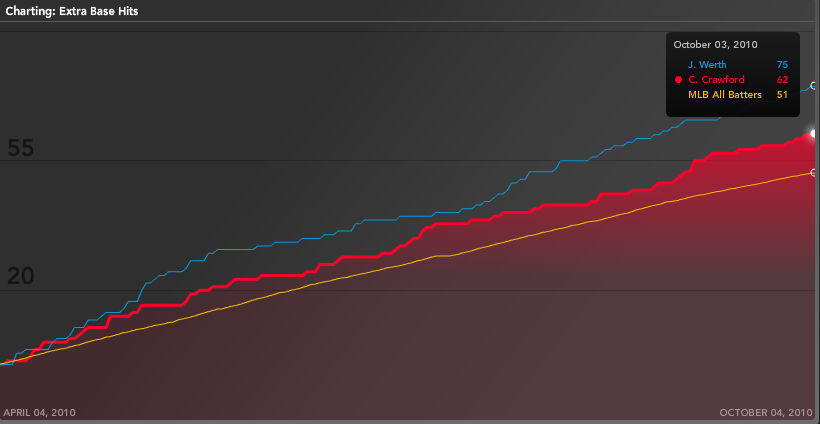
Everyone knows that Crawford’s main asset is speed. That said, in recent seasons he has taken a few more walks. He also showed more power this season with a career-high 62 extra-base hits. Although Tropicana Field has taken a toll on his legs, he has avoided major injury to those valuable wheels.
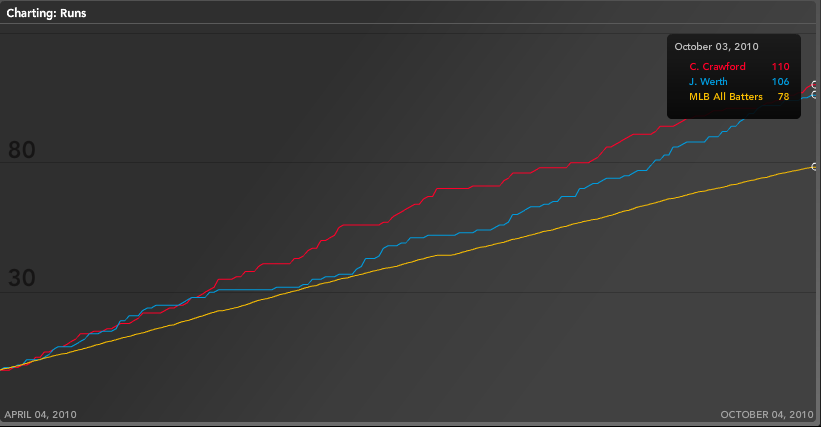
Looking at short-term value, Werth is likely the better offensive player for 2011 – even though Crawford is the superior fantasy commodity given his prodigious speed. Werth’s power potential is much greater, and it’s not just tied to balls leaving the yard. He led the league with 46 doubles in 2010 and could rack up even more in a place like Fenway Park. However, if you’re looking for a keeper between the two, Crawford is the one. He will continue to offer tremendous value in steals, as well as providing an above-average number of extra-base hits for the next few years. In conjunction with steals and extra bases, He should score a lot of runs in a good lineup as well.
For more on Carl Crawford, Jayson Werth, and other MLB Free Agents check out Bloomberg Sports’ Front Office.
MLB Season in Review: Houston Astros Pitchers
By Eno Sarris //
Biggest Surprise: Wilton Lopez
How does a pitcher who doesn’t strike out batters at an average rate for relievers (6.72 K/9, reliever average well above 7 K/9) become the best reliever in his pen? Lopez did it by not walking anyone (five all year, or 0.67 BB/9) and keeping the ball on the ground (55.7%). Those aren’t always the traits of a great closer – managers love the strikeout – and so Lopez may not be fantasy-relevant in most leagues. But if your league counts holds, or you are looking for a reliever to keep your ratios down, remember this name.
Biggest Bust: Bud Norris
If you’re looking for strikeouts, Norris could be your man; if he could pick up some of that control from Lopez through osmosis, he’d be a veritable ace. He struck out more than a man per inning (9.25 K/9), and that’s valuable. But he struggled to locate his secondary stuff, and his walks spiked as a result (4.51 BB/9). Given that he’s also a flyball pitcher (41.4% groundballs for his career), he’ll really need to cut down on the walks to fulfill his promise in the starting rotation.
2011 Keeper Alert: Wandy Rodriguez
Rodriguez struggled out of the gate (4.97 ERA, 1.52 WHIP before the All-Star game), but a fine second half brought him back to upper-echelon levels (3.60 ERA, 1.29 WHIP). Though his strikeout (8.22 K/9) and walk (3.14 BB/9) rates were the worst he’s shown in three years, they were still strong. He’s a little older than you might think (32 next season), but in the short-term he’s still a good keeper on a staff mostly devoid of young keeper pitching. J.A. Happ, for instance, strikes out more than a full batter fewer than Rodriguez, and usually walks at least a half-batter or more than him too.
2011 Regression Alert: Felipe Paulino
Paulino is a little like Bud Norris in that he can strike a batter out (8.15 K/9 last year), struggles with control (4.52 BB/9 last year), and put up a stinker of an ERA in 2010 (5.11). But Paulino may have an easier time harnessing his stuff. In his first 100 major league innings, he walked fewer than 3.5 batters per nine innings, and even after a poor second 100 innings, he’s got a manageable 3.89 BB/9 for his career. As a flyballer, he’ll always be a little vulnerable to the gopherball. But look for that unsightly ERA to improve next year if his control settled toward career norms.
Derek Jeter’s Bleak Future
By R.J. Anderson //
Derek Jeter is a free agent by name only. The Yankees’ only conundrum in re-signing their captain will be similar to the ones the Bombers faced with Andy Pettitte last offseason: how long and for how much?
Those questions are not easy to answer in this case, because Jeter’s marketing power and brand are unrivaled. The Yankees’ own brand would not suffer from losing Jeter – they were popular before him too, you know – but they have no reason to pass on him (despite diminishing skills) because a sunk cost is no big deal to New York.
Jeter’s 2010 season represents a massive disappointment. Fresh off a season in which hit .334/.406/.465 with 18 home runs, Jeter failed to come near those numbers. His batting average slipped under .300 (to .270) for the first time since 2004. His on-base percentage fell below .350 (.340) for the first time in his career – the same can be said of his slugging percentage ending at less than .400. Jeter still managed 10 home runs and 18 stolen bases, but his mediocre stats and slap-hitting ways might represent the future more than Yankees fans would like to believe.
In June, Jeter will turn 37. No shortstop (defined by having played at least 50% of their games at the position along with 300 plate appearances) aged at least 37 has ever hit more than nine home runs in a season. Since 1970, only 20 shortstops met that qualification after turning 37, with the highest batting average being .295, the highest on-base percentage being .367, and the highest slugging percentage being .419. Over the last three seasons, Jeter’s line: .301/.369/.414. Meanwhile, only two of those players finished with an OPS above the league’s average.
In other words, Jeter’s not likely to get much better than he’s played lately as he ages. The crowd perception is that Jeter will get a deal worth three years at roughly $15 million per year. Even though three years does not seem like a long time, one has to wonder if Jeter’s increasing immobility at shortstop along with the presence of prospect Eduardo Nunez will result in the Yankees moving Jeter to the outfield or full-time DH before the contract expires. Moving him becomes a definite if the Yankees foolishly give in to Jeter’s supposed desire for six years. Consider the idea admirable – in the sense that Jeter loves to play and really wants to test the limits of his icon boundaries – but also insane.
As for your fantasy docket, one would expect him to be undervalued entering next season, and there’s something possibility for a bit of positive regression after such a huge year-over-year drop. Still, in most leagues Jeter’s name value will inflate his bidding price beyond a reasonable range.
Tread softly and do not be afraid to let him go. Unlike the Yankees, you have a choice.
For more on Derek Jeter and other free agents, check out Bloomberg Sports’ Fantasy Tools.
Revisiting the Fantasy Value of Madison Bumgarner
by Eno Sarris //
Back in July, we took a look at Madison Bumgarner and found some reasons to be suspicious of his early success. As a short recap, here are those reasons in helpful bullet form.
- His velocity was down from the mid-nineties to barely cracking 90 MPH.
- His strikeout rate was below-average (6.75 K/9, average was 7.13 K/9 this year).
- He was getting lucky, with a .266 batting average on balls in play (BABIP) and an 82.7% strand rate (numbers that trend to .300 and 70% across baseball).
All of these shortcomings were notable at the time, given his history and velocity. But now we are looking at Madison Bumgarner, World Series Beast. Perhaps it’s time to revisit our initial findings on Bumgarner and see if he should get a revised rating.
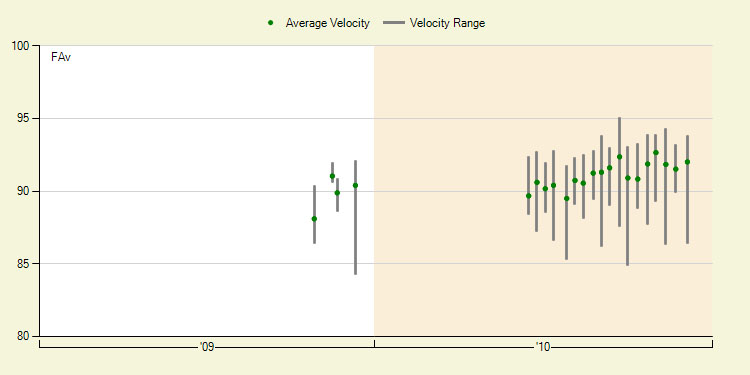
First, his velocity. Bumgarner throws across his body, and he’s not a very thick guy, so there were reasons to be worried about a drop in velocity. Sometimes it’s a harbinger of injury. But then Bumgarner went out and improved that velocity all year – it’s now steady at 91 MPH, touching the mid-90s some games. If you look at his fastball velocity chart below, you see there might still be some issues (the bars represent full velocity range for each game), but it also shows that he found some oomph.
 Bumgarner rode that improved velocity to an improved strikeout rate, ending the year at 6.97 K/9. Perhaps we focused too heavily on his strikeout rate, however. His walk rate is so low (2.11 BB/9 in 2010, 2.16 career) that his K/BB is well above average. Had he qualified for the ERA title, his 3.31 K/BB would have ranked 15th in baseball – tied with a pretty decent pitcher named Felix Hernandez.
Largely because of this ability to limit walks, Bumgarner’s work stood up even when his luck regressed to the mean. He ended the year with a .322 BABIP, so many more hits fell, and yet he finished the year with an even 3.00 ERA. His strand rate remained high (81.7%), but his FIP (a number on the ERA scale that strips out batted-ball luck and other factors largely beyond a pitcher’s control) was still strong at 3.66.
Upside remains. Bumgarner once struck out double-digit batters per nine innings in the minor leagues, and obviously his postseason performance has shown that he has the ability to punch batters out. Because he can limit walks, it looks like the worst-case scenario has shifted in his favor. Without reaching his upside fully and pushing the strikeout rate further, he may not be the ace that was hoped for him, but we can now be more positive about his future.
For more on Madison Bumgarner and other young pitchers, check out Bloomberg Sports’ Fantasy Tools.
MLB Season in Review: Houston Astros Hitting
By Eno Sarris //
Biggest Surprise & Regression Alert: Chris Johnson
Chris Johnson was a revelation in an otherwise poor season for the Astros; Houston scored the third-fewest runs in baseball in 2010. His .308/.337/.481 rookie batting line is in the books, but can he make a repeat performance in 2011? It’s not likely. His minor league isolated power (ISO) was only about average (.152, major league average is .150), so the power he showed last year (.173 ISO) was a little high – not impossible to replicate, but don’t bet on it either. The bigger issues: Johnson’s plate discipline (4.2% career BB%, 26.7% career K%) and elevated 2010 batting average on balls in play (.387 BABIP last year, a number that trends towards .300 across baseball), point to a big potential drop in batting average next year.
Biggest Bust: Lance Berkman
Tommy Manzanella was terrible, but he was mostly known for his defense anyway. Carlos Lee also had a poor season, but turned it on late to get to 24 home runs and some respectability – at least from a fantasy perspective. Michael Bourn didn’t have a great batting average, but still stole 52 bases. That leaves Lance Berkman. He was injured much of the season, and didn’t crack 500 plate appearances for the first time since his sophomore season in 2000. His knee condition may be degenerative, and he’s seen a three-year decline in slugging and on-base percentages now. He’s best left for the deepest of leagues until he shows life again.
2011 Keeper Alert: Brett Wallace
Hunter Pence is the only no-doubt keeper on this offense, but Brett Wallace is the only interesting player who has yet to establish himself in the major leagues. Coming off his minor league record, in which he put up a .304/.375/.487 batting line, more was expected of him than his rookie-year stats (.222/.296/.319). Then again, many of his better power years in the minor leagues came in high-run environments, so his power might be suspect. In his 159-plate appearance major league debut, he didn’t show the ability to take a walk (5%), struck out too much (34.7%) and didn’t show any power. He’s a deep-league sleeper and an NL-only dynasty keeper at most, but he’s also a name worth remembering, if only for potential help in the batting average category if and when he gets going.
 Bloomberg Sports